ARG46014
anti-APPBP2 antibody
anti-APPBP2 antibody for Western blot,IHC-Formalin-fixed paraffin-embedded sections and Human,Mouse,Rat
Overview
| Product Description | Rabbit Polyclonal antibody recognizes APPBP2 |
|---|---|
| Tested Reactivity | Hu, Ms, Rat |
| Tested Application | IHC-P, WB |
| Host | Rabbit |
| Clonality | Polyclonal |
| Isotype | IgG |
| Target Name | APPBP2 |
| Antigen Species | Human |
| Immunogen | A 18 amino acid synthetic peptide within the last 50 amino acids of human APPBP2. |
| Conjugation | Un-conjugated |
| Alternate Names | amyloid beta precursor protein (cytoplasmic tail) binding protein 2; APPBP2; PAT1; APP-BP2; HS.84084; KIAA0228; PAT1; Amyloid protein-binding protein 2; Amyloid beta precursor protein-binding protein 2 |
Application Instructions
| Application Suggestion |
|
||||||
|---|---|---|---|---|---|---|---|
| Application Note | * The dilutions indicate recommended starting dilutions and the optimal dilutions or concentrations should be determined by the scientist. | ||||||
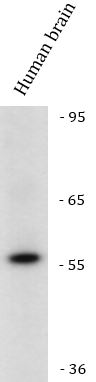
| Observed Size | 57 kDa |
Properties
| Purification | Affinity chromatography purified |
|---|---|
| Buffer | PBS and 0.02% Sodium azide. |
| Preservative | 0.02% Sodium azide |
| Concentration | 1 mg/ml |
| Storage Instruction | For continuous use, store undiluted antibody at 2-8°C for up to a week. For long-term storage, aliquot and store at -64°C or below. Storage in frost free freezers is not recommended. Avoid repeated freeze/thaw cycles. Suggest spin the vial prior to opening. The antibody solution should be gently mixed before use. |
| Note | For laboratory research only, not for drug, diagnostic or other use. |
Bioinformation
| Database Links | |
|---|---|
| Gene Symbol | APPBP2 |
| Gene Full Name | amyloid beta precursor protein (cytoplasmic tail) binding protein 2 |
| Background | The protein encoded by this gene interacts with microtubules and is functionally associated with beta-amyloid precursor protein transport and/or processing. The beta-amyloid precursor protein is a cell surface protein with signal-transducing properties, and it is thought to play a role in the pathogenesis of Alzheimer's disease. The encoded protein may be involved in regulating cell death. This gene has been found to be highly expressed in breast cancer. Alternative splicing results in multiple transcript variants. [provided by RefSeq, Sep 2013] |
| Function | Substrate-recognition component of a Cul2-RING (CRL2) E3 ubiquitin-protein ligase complex of the DesCEND (destruction via C-end degrons) pathway, which recognizes a C-degron located at the extreme C terminus of target proteins, leading to their ubiquitination and degradation (PubMed:29775578, PubMed:29779948). The C-degron recognized by the DesCEND pathway is usually a motif of less than ten residues and can be present in full-length proteins, truncated proteins or proteolytically cleaved forms (PubMed:29775578, PubMed:29779948). The CRL2(APPBP2) complex specifically recognizes proteins with a -Arg-Xaa-Xaa-Gly degron at the C-terminus, leading to their ubiquitination and degradation (PubMed:29775578, PubMed:29779948). The CRL2(APPBP2) complex mediates ubiquitination and degradation of truncated SELENOV selenoproteins produced by failed UGA/Sec decoding, which end with a -Arg-Xaa-Xaa-Gly degron (PubMed:26138980). May play a role in intracellular protein transport: may be involved in the translocation of APP along microtubules toward the cell surface (PubMed:9843960). [UniProt] |
| Cellular Localization | Nucleus; Cytoplasm. [UniProt] |
| Calculated MW | 64 kDa |
| PTM | Phosphoprotein. [UniProt] |
Images (2) Click the Picture to Zoom In
-
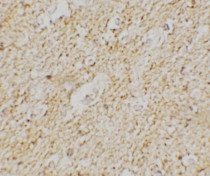
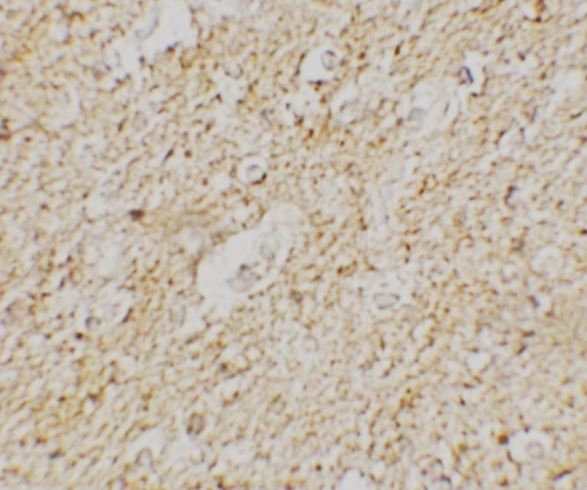
ARG46014 anti-APPBP2 antibody IHC-P image
Immunohistochemistry: Human brain stained with ARG46014 anti-APPBP2 antibody.
-
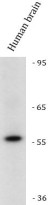
ARG46014 anti-APPBP2 antibody WB image
Western blot: Human brain stained with ARG46014 anti-APPBP2 antibody.