ARG46025
anti-ATOH8 antibody
anti-ATOH8 antibody for Western blot,IHC-Formalin-fixed paraffin-embedded sections and Human,Mouse,Rat
Overview
| Product Description | Rabbit Polyclonal antibody recognizes ATOH8 |
|---|---|
| Tested Reactivity | Hu, Ms, Rat |
| Tested Application | IHC-P, WB |
| Host | Rabbit |
| Clonality | Polyclonal |
| Isotype | IgG |
| Target Name | ATOH8 |
| Antigen Species | Human |
| Immunogen | A 15 amino acid synthetic peptide within the last 50 amino acids of human ATOH8. |
| Conjugation | Un-conjugated |
| Alternate Names | atonal homolog 8 (Drosophila); ATOH8; HATH6; bHLHa21; ATH6; BHLHA21; Protein atonal homolog 8; Class A basic helix-loop-helix protein 21 |
Application Instructions
| Application Suggestion |
|
||||||
|---|---|---|---|---|---|---|---|
| Application Note | * The dilutions indicate recommended starting dilutions and the optimal dilutions or concentrations should be determined by the scientist. | ||||||
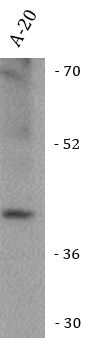
| Observed Size | 40 kDa |
Properties
| Purification | Affinity chromatography purified |
|---|---|
| Buffer | PBS and 0.02% Sodium azide. |
| Preservative | 0.02% Sodium azide |
| Concentration | 1 mg/ml |
| Storage Instruction | For continuous use, store undiluted antibody at 2-8°C for up to a week. For long-term storage, aliquot and store at -75°C or below. Storage in frost free freezers is not recommended. Avoid repeated freeze/thaw cycles. Suggest spin the vial prior to opening. The antibody solution should be gently mixed before use. |
| Note | For laboratory research only, not for drug, diagnostic or other use. |
Bioinformation
| Database Links | |
|---|---|
| Gene Symbol | ATOH8 |
| Gene Full Name | atonal homolog 8 (Drosophila) |
| Background | Enables DNA-binding transcription factor activity and E-box binding activity. Involved in several processes, including positive regulation of SMAD protein signal transduction; positive regulation of endothelial cell differentiation; and regulation of gene expression. Located in nucleoplasm. [provided by Alliance of Genome Resources, Jul 2025] |
| Function | Transcription factor that binds a palindromic (canonical) core consensus DNA sequence 5'-CANNTG- 3' known as an E-box element, possibly as a heterodimer with other bHLH proteins (PubMed:24236640). Regulates endothelial cell proliferation, migration and tube-like structures formation (PubMed:24463812). Modulates endothelial cell differentiation through NOS3 (PubMed:24463812). May be implicated in specification and differentiation of neuronal cell lineages in the brain (By similarity). May participate in kidney development and may be involved in podocyte differentiation (By similarity). During early embryonic development is involved in tissue-specific differentiation processes that are dependent on class II bHLH factors and namely modulates the differentiation program initiated by the pro-endocrine factor NEUROG3 (By similarity). During myogenesis, may play a role during the transition of myoblasts from the proliferative phase to the differentiation phase (By similarity). Positively regulates HAMP transcription in two ways, firstly by acting directly on the HAMP promoter via E-boxes binding and indirectly through increased phosphorylation of SMAD protein complex (PubMed:24236640). Repress NEUROG3-dependent gene activation in a gene-specific manner through at least two mechanisms; requires only either the sequestering of a general partner such as TCF3 through heterodimerization, either also requires binding of the bHLH domain to DNA via a basic motif (By similarity). [UniProt] |
| Cellular Localization | Nucleus; Cytoplasm. [UniProt] |
| Calculated MW | 35 kDa |
| PTM | Phosphoprotein. [UniProt] |
Images (2) Click the Picture to Zoom In
-
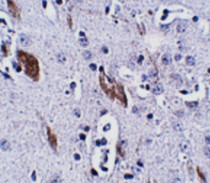
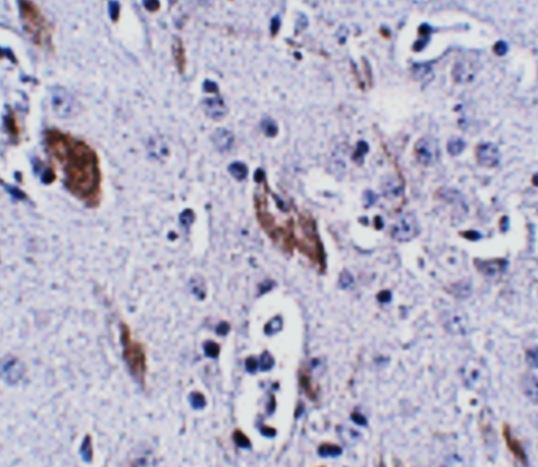
ARG46025 anti-ATOH8 antibody IHC-P image
Immunohistochemistry: Mouse brain stained with ARG46025 anti-ATOH8 antibody.
-
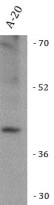
ARG46025 anti-ATOH8 antibody WB image
Western blot: A-20 stained with ARG46025 anti-ATOH8 antibody.