ARG41151
anti-ATP6V0D1 / p39 antibody
anti-ATP6V0D1 / p39 antibody for Western blot and Human,Rat
Overview
| Product Description | Rabbit Polyclonal antibody recognizes ATP6V0D1 / p39 |
|---|---|
| Tested Reactivity | Hu, Rat |
| Tested Application | WB |
| Host | Rabbit |
| Clonality | Polyclonal |
| Isotype | IgG |
| Target Name | ATP6V0D1 / p39 |
| Antigen Species | Human |
| Immunogen | KLH-conjugated synthetic peptide within the center region of Human ATP6V0D1 / p39. |
| Conjugation | Un-conjugated |
| Alternate Names | Vacuolar proton pump subunit d 1; VPATPD; V-ATPase subunit d 1; 32 kDa accessory protein; VATX; ATP6DV; V-type proton ATPase subunit d 1; V-ATPase AC39 subunit; P39; VMA6; p39; ATP6D; V-ATPase 40 kDa accessory protein |
Application Instructions
| Application Suggestion |
|
||||
|---|---|---|---|---|---|
| Application Note | * The dilutions indicate recommended starting dilutions and the optimal dilutions or concentrations should be determined by the scientist. | ||||
| Observed Size | 40 kDa |
Properties
| Form | Liquid |
|---|---|
| Purification | Affinity purification with immunogen. |
| Buffer | 0.42% Potassium phosphate (pH 7.3), 0.87% NaCl, 0.01% Sodium azide and 30% Glycerol. |
| Preservative | 0.01% Sodium azide |
| Stabilizer | 30% Glycerol |
| Storage Instruction | For continuous use, store undiluted antibody at 2-8°C for up to a week. For long-term storage, aliquot and store at -20°C. Storage in frost free freezers is not recommended. Avoid repeated freeze/thaw cycles. Suggest spin the vial prior to opening. The antibody solution should be gently mixed before use. |
| Note | For laboratory research only, not for drug, diagnostic or other use. |
Bioinformation
| Database Links | |
|---|---|
| Gene Symbol | ATP6V0D1 |
| Gene Full Name | ATPase, H+ transporting, lysosomal 38kDa, V0 subunit d1 |
| Background | This gene encodes a component of vacuolar ATPase (V-ATPase), a multisubunit enzyme that mediates acidification of eukaryotic intracellular organelles. V-ATPase dependent organelle acidification is necessary for such intracellular processes as protein sorting, zymogen activation, receptor-mediated endocytosis, and synaptic vesicle proton gradient generation. V-ATPase is composed of a cytosolic V1 domain and a transmembrane V0 domain. The V1 domain consists of three A and three B subunits, two G subunits plus the C, D, E, F, and H subunits. The V1 domain contains the ATP catalytic site. The V0 domain consists of five different subunits: a, c, c', c'', and d. Additional isoforms of many of the V1 and V0 subunit proteins are encoded by multiple genes or alternatively spliced transcript variants. This encoded protein is known as the D subunit and is found ubiquitously. [provided by RefSeq, Jul 2008] |
| Function | Subunit of the integral membrane V0 complex of vacuolar ATPase. Vacuolar ATPase is responsible for acidifying a variety of intracellular compartments in eukaryotic cells, thus providing most of the energy required for transport processes in the vacuolar system. May play a role in coupling of proton transport and ATP hydrolysis (By similarity). May play a role in cilium biogenesis through regulation of the transport and the localization of proteins to the cilium (By similarity). [UniProt] |
| Cellular Localization | Membrane; Peripheral membrane protein; Cytoplasmic side. Note=Localizes to centrosome and the base of the cilium. [UniProt] |
| Calculated MW | 40 kDa |
Images (1) Click the Picture to Zoom In
-
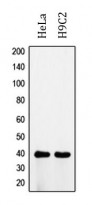
ARG41151 anti-ATP6V0D1 / p39 antibody WB image
Western blot: HeLa and H9C2 whole cell lysates stained with ARG41151 anti-ATP6V0D1 / p39 antibody.