ARG24196
anti-ATR Phospho (Thr1989) antibody
anti-ATR Phospho (Thr1989) antibody for ICC/IF,Western blot and Human,Mouse
Overview
| Product Description | Rabbit Polyclonal antibody recognizes ATR Phospho (Thr1989) |
|---|---|
| Tested Reactivity | Hu, Ms |
| Predict Reactivity | Bov, Sheep |
| Tested Application | ICC/IF, WB |
| Specificity | Phospho-ATR (Thr1989) Antibody detects endogenous levels of ATR only when phosphorylated at Thr1989. |
| Host | Rabbit |
| Clonality | Polyclonal |
| Isotype | IgG |
| Target Name | ATR |
| Antigen Species | Human |
| Immunogen | A synthesized peptide derived from human ATR around the phosphorylation site of Thr1989. |
| Conjugation | Un-conjugated |
| Alternate Names | FRP1; SCKL; FCTCS; FRAP-related protein 1; Serine/threonine-protein kinase ATR; EC 2.7.11.1; MEC1; SCKL1; Ataxia telangiectasia and Rad3-related protein |
Application Instructions
| Application Suggestion |
|
||||||
|---|---|---|---|---|---|---|---|
| Application Note | * The dilutions indicate recommended starting dilutions and the optimal dilutions or concentrations should be determined by the scientist. | ||||||
| Observed Size | 300 kDa |
Properties
| Form | Liquid |
|---|---|
| Purification | The antibody is from purified rabbit serum by affinity purification via sequential chromatography on phospho-peptide and non-phospho-peptide affinitycolumns. |
| Purification Note | 150mM NaCl, pH 7.4, 0.02% sodium azide and 50% Glycerol |
| Purity | 0.02% Sodium azide |
| Buffer | 50% Glycerol |
| Storage Instruction | For continuous use, store undiluted antibody at 2-8°C for up to a week. For long-term storage, aliquot and store at -20°C or below. Storage in frost free freezers is not recommended. Avoid repeated freeze/thaw cycles. Suggest spin the vial prior to opening. The antibody solution should be gently mixed before use. |
| Note | For laboratory research only, not for drug, diagnostic or other use. |
Bioinformation
| Database Links |
Swiss-port # Q13535 Human Serine/threonine-protein kinase ATR |
|---|---|
| Gene Symbol | ATR |
| Gene Full Name | ATR serine/threonine kinase |
| Background | The protein encoded by this gene belongs the PI3/PI4-kinase family, and is most closely related to ATM, a protein kinase encoded by the gene mutated in ataxia telangiectasia. This protein and ATM share similarity with Schizosaccharomyces pombe rad3, a cell cycle checkpoint gene required for cell cycle arrest and DNA damage repair in response to DNA damage. This kinase has been shown to phosphorylate checkpoint kinase CHK1, checkpoint proteins RAD17, and RAD9, as well as tumor suppressor protein BRCA1. Mutations of this gene are associated with Seckel syndrome. An alternatively spliced transcript variant of this gene has been reported, however, its full length nature is not known. Transcript variants utilizing alternative polyA sites exist. [provided by RefSeq, Jul 2008] |
| Function | Serine/threonine protein kinase which activates checkpoint signaling upon genotoxic stresses such as ionizing radiation (IR), ultraviolet light (UV), or DNA replication stalling, thereby acting as a DNA damage sensor. Recognizes the substrate consensus sequence [ST]-Q. Phosphorylates BRCA1, CHEK1, MCM2, RAD17, RPA2, SMC1 and p53/TP53, which collectively inhibit DNA replication and mitosis and promote DNA repair, recombination and apoptosis. Phosphorylates 'Ser-139' of histone variant H2AX/H2AFX at sites of DNA damage, thereby regulating DNA damage response mechanism. Required for FANCD2 ubiquitination. Critical for maintenance of fragile site stability and efficient regulation of centrosome duplication. [UniProt] |
| Calculated MW | 301 kDa |
| PTM | Phosphorylated; autophosphorylates in vitro. [UniProt] |
Images (4) Click the Picture to Zoom In
-
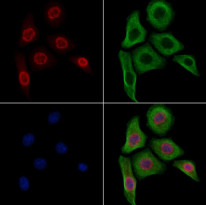
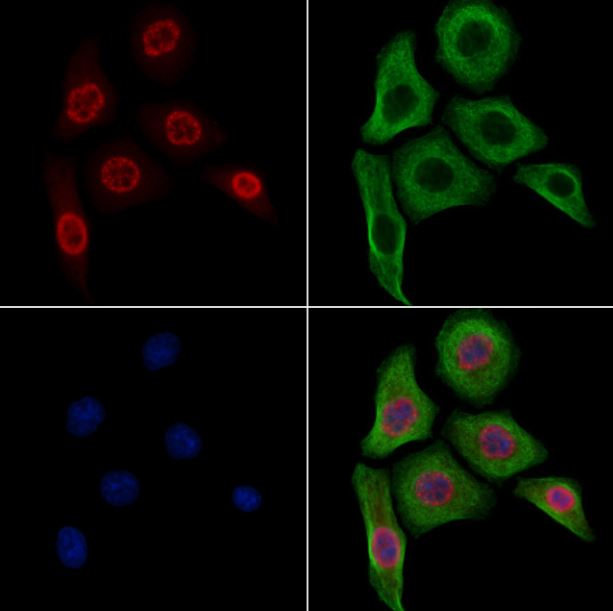
ARG24196 anti-ATR Phospho (Thr1989) antibody ICC/IF image
Immunofluorescence: Hela stained with ARG24196 anti-ATR Phospho (Thr1989) antibody.
-
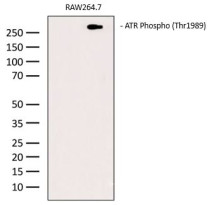
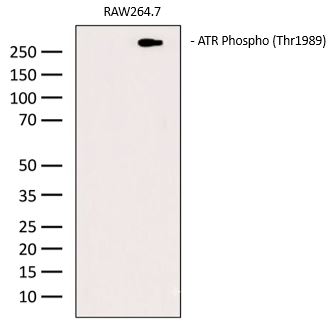
ARG24196 anti-ATR Phospho (Thr1989) antibody WB image
Western blot: LPS treated RAW264.7 stained with ARG24196 anti-ATR Phospho (Thr1989) antibody.
-
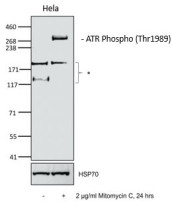
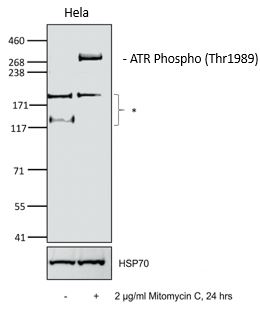
ARG24196 anti-ATR Phospho (Thr1989) antibody WB image
Western blot: Mitomycin C treated HeLa stained with ARG24196 anti-ATR Phospho (Thr1989) antibody.
-
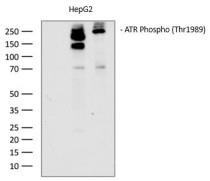
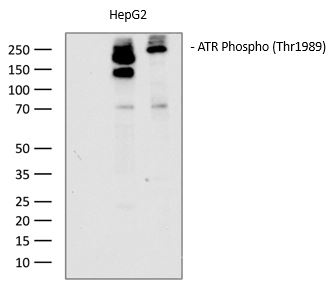
ARG24196 anti-ATR Phospho (Thr1989) antibody WB image
Western blot: Serum starvation or heat-shock treated HepG2 stained with ARG24196 anti-ATR Phospho (Thr1989) antibody.