ARG45995
anti-Angiogenin antibody
anti-Angiogenin antibody for Western blot and Human,Mouse,Rat
Overview
| Product Description | Rabbit Polyclonal antibody recognizes Angiogenin |
|---|---|
| Tested Reactivity | Hu, Ms, Rat |
| Tested Application | WB |
| Host | Rabbit |
| Clonality | Polyclonal |
| Isotype | IgG |
| Target Name | Angiogenin |
| Antigen Species | Human |
| Immunogen | A 15 amino acid synthetic peptide within aa. 70 - 120 of human Angiogenin. |
| Conjugation | Un-conjugated |
| Alternate Names | ANG; Angiogenin; RNASE5; RAA1; Angiogenin, Ribonuclease, RNase A Family, 5; Ribonuclease A Family Member 5; Ribonuclease 5; RNase 5; Epididymis Luminal Protein 168; Ribonuclease A A1; EC 3.1.27.- ; EC 3.1.27; HEL168; RNASE4; ALS9 |
Application Instructions
| Application Suggestion |
|
||||
|---|---|---|---|---|---|
| Application Note | * The dilutions indicate recommended starting dilutions and the optimal dilutions or concentrations should be determined by the scientist. |
Properties
| Purification | Affinity chromatography purified |
|---|---|
| Buffer | PBS and 0.02% Sodium azide. |
| Preservative | 0.02% Sodium azide |
| Concentration | 1 mg/ml |
| Storage Instruction | For continuous use, store undiluted antibody at 2-8°C for up to a week. For long-term storage, aliquot and store at -20°C. Storage in frost free freezers is not recommended. Avoid repeated freeze/thaw cycles. Suggest spin the vial prior to opening. The antibody solution should be gently mixed before use. |
| Note | For laboratory research only, not for drug, diagnostic or other use. |
Bioinformation
| Database Links | |
|---|---|
| Gene Symbol | ANG |
| Gene Full Name | Angiogenin |
| Background | The protein encoded by this gene is a member of the RNase A superfamily though it has relatively weak ribonucleolytic activity. This protein is a potent mediator of new blood vessel formation and thus, in addition to the name RNase5, is commonly called angiogenin. This protein induces angiogenesis after binding to actin on the surface of endothelial cells. This protein also accumulates at the nucleolus where it stimulates ribosomal transcription. Under stress conditions this protein translocates to the cytosol where it hydrolyzes cellular tRNAs and influences protein synthesis. A signal peptide is cleaved from the precursor protein to produce a mature protein which contains a nuclear localization signal, a cell binding motif, and a catalytic domain. This protein has been shown to be both neurotrophic and neuroprotective and the mature protein has antimicrobial activity against some bacteria and fungi, including S. pneumoniae and C. albicans. Due to its effect on rRNA production and angiogenesis this gene plays important roles in cell growth and tumor progression. Mutations in this gene are associated with progression of amyotrophic lateral sclerosis (ALS). This gene and the neighboring RNase4 gene share promoters and 5' exons though each gene then splices to a distinct 3' exon containing the complete coding region of each gene. Alternative splicing results in multiple transcript variants encoding the same protein. |
| Function | Ribonuclease that cleaves tRNA within anticodon loops to produce tRNA-derived stress-induced fragments (tiRNAs) which inhibit protein synthesis and triggers the assembly of stress granules (SGs). |
| Cellular Localization | Cytoplasmic vesicle, Nucleus, Secreted |
| Calculated MW | 17 kDa |
| PTM | Disulfide bond, Pyrrolidone carboxylic acid |
Images (1) Click the Picture to Zoom In
-
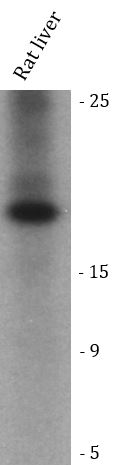
ARG45995 anti-Angiogenin antibody WB image
Western blot: Rat liver stained with ARG45995 anti-Angiogenin antibody.