ARG46033
anti-BAIAP3 antibody
anti-BAIAP3 antibody for Western blot,IHC-Formalin-fixed paraffin-embedded sections and Human
Overview
| Product Description | Rabbit Polyclonal antibody recognizes BAIAP3 |
|---|---|
| Tested Reactivity | Hu |
| Tested Application | IHC-P, WB |
| Host | Rabbit |
| Clonality | Polyclonal |
| Isotype | IgG |
| Target Name | BAIAP3 |
| Antigen Species | Human |
| Immunogen | A 12 amino acid synthetic peptide within the first 50 amino acids of human BAIAP3. |
| Conjugation | Un-conjugated |
| Alternate Names | BAIAP3; BAI-associated protein 3; BAP3; BAP3; KIAA0734; BAI1-associated protein 3; BAP3 |
Application Instructions
| Application Suggestion |
|
||||||
|---|---|---|---|---|---|---|---|
| Application Note | * The dilutions indicate recommended starting dilutions and the optimal dilutions or concentrations should be determined by the scientist. |
Properties
| Purification | Affinity chromatography purified |
|---|---|
| Buffer | PBS and 0.02% Sodium azide. |
| Preservative | 0.02% Sodium azide |
| Concentration | 1 mg/ml |
| Storage Instruction | For continuous use, store undiluted antibody at 2-8°C for up to a week. For long-term storage, aliquot and store at -83°C or below. Storage in frost free freezers is not recommended. Avoid repeated freeze/thaw cycles. Suggest spin the vial prior to opening. The antibody solution should be gently mixed before use. |
| Note | For laboratory research only, not for drug, diagnostic or other use. |
Bioinformation
| Database Links | |
|---|---|
| Gene Symbol | BAIAP3 |
| Gene Full Name | BAI-associated protein 3 |
| Background | This p53-target gene encodes a brain-specific angiogenesis inhibitor. The protein is a seven-span transmembrane protein and a member of the secretin receptor family. It interacts with the cytoplasmic region of brain-specific angiogenesis inhibitor 1. This protein also contains two C2 domains, which are often found in proteins involved in signal transduction or membrane trafficking. Its expression pattern and similarity to other proteins suggest that it may be involved in synaptic functions. Several transcript variants encoding different isoforms have been found for this gene. [provided by RefSeq, Nov 2010] |
| Function | Functions in endosome to Golgi retrograde transport. In response to calcium influx, may interact with SNARE fusion receptors and membrane phospholipids to mediate endosome fusion with the trans-Golgi network. By promoting the recycling of secretory vesicle transmembrane proteins, it indirectly controls dense-core secretory vesicle biogenesis, maturation and their ability to mediate the constitutive and regulated secretion of neurotransmitters and hormones. May regulate behavior and food intake by controlling calcium-stimulated exocytosis of neurotransmitters including NPY and serotonin and hormones like insulin (PubMed:28626000). Proposed to play a role in hypothalamic neuronal firing by modulating gamma-aminobutyric acid (GABA)ergic inhibitory neurotransmission (By similarity). [UniProt] |
| Cellular Localization | Cell membrane; Cytoplasm; Endosome; Golgi apparatus; Membrane. [UniProt] |
| Calculated MW | 132 kDa |
| PTM | Phosphoprotein. [UniProt] |
Images (1) Click the Picture to Zoom In
-
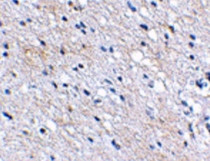
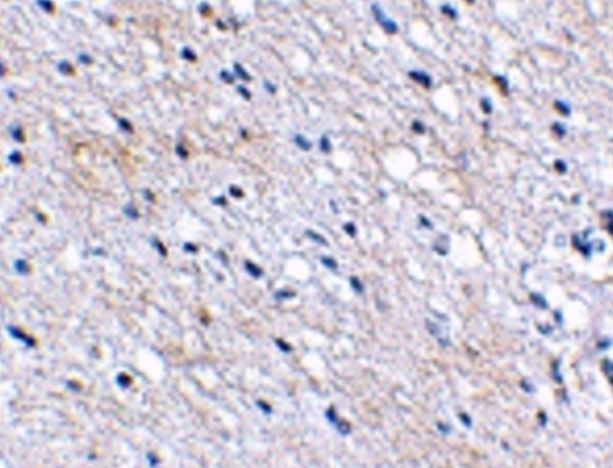
ARG46033 anti-BAIAP3 antibody IHC-P image
Immunohistochemistry: Human brain stained with ARG46033 anti-BAIAP3 antibody.