ARG46051
anti-BRCC45 antibody
anti-BRCC45 antibody for Western blot,IHC-Formalin-fixed paraffin-embedded sections and Human,Mouse,Rat
Overview
| Product Description | Rabbit Polyclonal antibody recognizes BRCC45 |
|---|---|
| Tested Reactivity | Hu, Ms, Rat |
| Tested Application | IHC-P, WB |
| Host | Rabbit |
| Clonality | Polyclonal |
| Isotype | IgG |
| Target Name | BRCC45 |
| Antigen Species | Human |
| Immunogen | A 18 amino acid synthetic peptide within the last 50 amino acids of human BRCC45. |
| Conjugation | Un-conjugated |
| Alternate Names | BRE; brain and reproductive organ-expressed (TNFRSF1A modulator); BRCC45; BRCC4; BRCC45; BRCA1-A complex subunit BRE; Brain and reproductive organ-expressed protein |
Application Instructions
| Application Suggestion |
|
||||||
|---|---|---|---|---|---|---|---|
| Application Note | * The dilutions indicate recommended starting dilutions and the optimal dilutions or concentrations should be determined by the scientist. |
Properties
| Purification | Affinity chromatography purified |
|---|---|
| Buffer | PBS and 0.02% Sodium azide. |
| Preservative | 0.02% Sodium azide |
| Concentration | 1 mg/ml |
| Storage Instruction | For continuous use, store undiluted antibody at 2-8°C for up to a week. For long-term storage, aliquot and store at -101°C or below. Storage in frost free freezers is not recommended. Avoid repeated freeze/thaw cycles. Suggest spin the vial prior to opening. The antibody solution should be gently mixed before use. |
| Note | For laboratory research only, not for drug, diagnostic or other use. |
Bioinformation
| Database Links | |
|---|---|
| Gene Symbol | BRE |
| Gene Full Name | brain and reproductive organ-expressed (TNFRSF1A modulator) |
| Background | This gene encodes an anti-apoptotic, death receptor-associated protein that interacts with tumor necrosis factor-receptor-1. The encoded protein acts as an adapter in several protein complexes, including the BRCA1-A complex and the BRISC complex. The BRCA1-A complex possesses ubiquitinase activity and targets sites of double strand DNA breaks, while the BRISC complex exhibits deubiquitinase activity and is involved in mitotic spindle assembly. This gene is upregulated in several types of cancer. [provided by RefSeq, Jun 2016] |
| Function | Component of the BRCA1-A complex, a complex that specifically recognizes 'Lys-63'-linked ubiquitinated histones H2A and H2AX at DNA lesions sites, leading to target the BRCA1-BARD1 heterodimer to sites of DNA damage at double-strand breaks (DSBs). The BRCA1-A complex also possesses deubiquitinase activity that specifically removes 'Lys-63'-linked ubiquitin on histones H2A and H2AX (PubMed:17525341, PubMed:19261746, PubMed:19261748, PubMed:19261749). In the BRCA1-A complex, it acts as an adapter that bridges the interaction between BABAM1/NBA1 and the rest of the complex, thereby being required for the complex integrity and modulating the E3 ubiquitin ligase activity of the BRCA1-BARD1 heterodimer (PubMed:19261748, PubMed:21282113). Component of the BRISC complex, a multiprotein complex that specifically cleaves 'Lys-63'-linked ubiquitin in various substrates (PubMed:19214193, PubMed:24075985, PubMed:25283148, PubMed:26195665). Within the BRISC complex, acts as an adapter that bridges the interaction between BABAM1/NBA1 and the rest of the complex, thereby being required for the complex integrity (PubMed:21282113). The BRISC complex is required for normal mitotic spindle assembly and microtubule attachment to kinetochores via its role in deubiquitinating NUMA1 (PubMed:26195665). The BRISC complex plays a role in interferon signaling via its role in the deubiquitination of the interferon receptor IFNAR1; deubiquitination increases IFNAR1 activity by enhancing its stability and cell surface expression (PubMed:24075985). Down-regulates the response to bacterial lipopolysaccharide (LPS) via its role in IFNAR1 deubiquitination (PubMed:24075985). May play a role in homeostasis or cellular differentiation in cells of neural, epithelial and germline origins. May also act as a death receptor-associated anti-apoptotic protein, which inhibits the mitochondrial apoptotic pathway. May regulate TNF-alpha signaling through its interactions with TNFRSF1A; however these effects may be indirect (PubMed:15465831). [UniProt] |
| Cellular Localization | Cytoplasm; Nucleus. [UniProt] |
| Calculated MW | 44 kDa |
| PTM | Phosphoprotein. [UniProt] |
Images (2) Click the Picture to Zoom In
-
ARG46051 anti-BRCC45 antibody IHC-P image
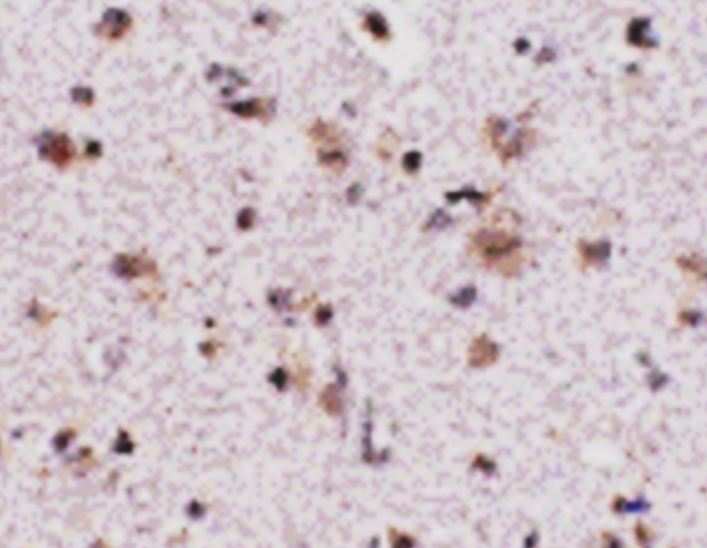
Immunohistochemistry: Human brain stained with ARG46051 anti-BRCC45 antibody.
-

ARG46051 anti-BRCC45 antibody WB image
Western blot: HeLa stained with ARG46051 anti-BRCC45 antibody.