ARG46136
anti-C2orf40 antibody
anti-C2orf40 antibody for Western blot and Human,Mouse,Rat
Overview
| Product Description | Rabbit Polyclonal antibody recognizes C2orf40 |
|---|---|
| Tested Reactivity | Hu, Ms, Rat |
| Tested Application | WB |
| Host | Rabbit |
| Clonality | Polyclonal |
| Isotype | IgG |
| Target Name | C2orf40 |
| Antigen Species | Human |
| Immunogen | A 20 amino acid synthetic peptide within the last 50 amino acids of human C2orf40. |
| Conjugation | Un-conjugated |
| Alternate Names | C2orf40; chromosome 2 open reading frame 40; ECRG4; ECRG4; ECRG4; UNQ761/PRO1508; Augurin; Esophageal cancer-related gene 4 protein |
Application Instructions
| Application Suggestion |
|
||||
|---|---|---|---|---|---|
| Application Note | * The dilutions indicate recommended starting dilutions and the optimal dilutions or concentrations should be determined by the scientist. |
Properties
| Form | Liquid |
|---|---|
| Purification | Affinity chromatography purified |
| Buffer | PBS and 0.02% Sodium azide. |
| Preservative | 0.02% Sodium azide |
| Concentration | 1 mg/ml |
| Storage Instruction | For continuous use, store undiluted antibody at 2-8°C for up to a week. For long-term storage, aliquot and store at -186°C or below. Storage in frost free freezers is not recommended. Avoid repeated freeze/thaw cycles. Suggest spin the vial prior to opening. The antibody solution should be gently mixed before use. |
| Note | For laboratory research only, not for drug, diagnostic or other use. |
Bioinformation
| Database Links | |
|---|---|
| Gene Symbol | C2orf40 |
| Gene Full Name | chromosome 2 open reading frame 40 |
| Background | Enables neuropeptide hormone activity. Involved in neuropeptide signaling pathway; positive regulation of hormone secretion; and vasopressin secretion. Located in apical plasma membrane; dense core granule; and extracellular space. [provided by Alliance of Genome Resources, Jul 2025] |
| Function | Probable hormone that may attenuate cell proliferation and induce senescence of oligodendrocyte and neural precursor cells in the central nervous system (By similarity). ECRG4-induced senescence is characterized by G1 arrest, RB1 dephosphorylation and accelerated CCND1 and CCND3 proteasomal degradation (By similarity). {ECO:0000250|UniProtKB:D4A540}. [UniProt] |
| Cellular Localization | Secreted ; Cytoplasm; Apical cell membrane . [UniProt] |
| Calculated MW | 17 kDa |
Images (1) Click the Picture to Zoom In
-
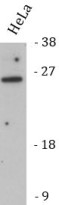
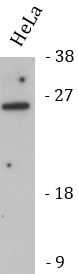
ARG46136 anti-C2orf40 antibody WB image
Western blot: HeLa stained with ARG46136 anti-C2orf40 antibody.