ARG46062
anti-CARD14 antibody
anti-CARD14 antibody for IHC-Formalin-fixed paraffin-embedded sections and Human
Overview
| Product Description | Rabbit Polyclonal antibody recognizes CARD14 |
|---|---|
| Tested Reactivity | Hu |
| Tested Application | IHC-P |
| Host | Rabbit |
| Clonality | Polyclonal |
| Isotype | IgG |
| Target Name | CARD14 |
| Antigen Species | Human |
| Immunogen | A 14 amino acid synthetic peptide within the last 50 amino acids of human CARD14. |
| Conjugation | Un-conjugated |
| Alternate Names | CARD14; caspase recruitment domain family, member 14; CARMA2; PRP; PSS1; BIMP2; CARMA2; PSORS2; Caspase recruitment domain-containing protein 14; CARD-containing MAGUK protein 2; Carma 2 |
Application Instructions
| Application Suggestion |
|
||||
|---|---|---|---|---|---|
| Application Note | * The dilutions indicate recommended starting dilutions and the optimal dilutions or concentrations should be determined by the scientist. |
Properties
| Purification | Affinity chromatography purified |
|---|---|
| Buffer | PBS and 0.02% Sodium azide. |
| Preservative | 0.02% Sodium azide |
| Concentration | 1 mg/ml |
| Storage Instruction | For continuous use, store undiluted antibody at 2-8°C for up to a week. For long-term storage, aliquot and store at -112°C or below. Storage in frost free freezers is not recommended. Avoid repeated freeze/thaw cycles. Suggest spin the vial prior to opening. The antibody solution should be gently mixed before use. |
| Note | For laboratory research only, not for drug, diagnostic or other use. |
Bioinformation
| Database Links |
Swiss-port # Q9BXL6 Human Caspase recruitment domain-containing protein 14 |
|---|---|
| Gene Symbol | CARD14 |
| Gene Full Name | caspase recruitment domain family, member 14 |
| Background | This gene encodes a caspase recruitment domain-containing protein that is a member of the membrane-associated guanylate kinase (MAGUK) family of proteins. Members of this protein family are scaffold proteins that are involved in a diverse array of cellular processes including cellular adhesion, signal transduction and cell polarity control. This protein has been shown to specifically interact with BCL10, a protein known to function as a positive regulator of cell apoptosis and NF-kappaB activation. Alternate splicing results in multiple transcript variants. [provided by RefSeq, Apr 2012] |
| Function | Acts as a scaffolding protein that can activate the inflammatory transcription factor NF-kappa-B and p38/JNK MAP kinase signaling pathways. Forms a signaling complex with BCL10 and MALT1, and activates MALT1 proteolytic activity and inflammatory gene expression. MALT1 is indispensable for CARD14-induced activation of NF-kappa-B and p38/JNK MAP kinases (PubMed:11278692, PubMed:21302310, PubMed:27071417, PubMed:27113748). May play a role in signaling mediated by TRAF2, TRAF3 and TRAF6 and protects cells against apoptosis. [UniProt] |
| Cellular Localization | Cytoplasm. [UniProt] |
| Calculated MW | 113 kDa |
| PTM | Phosphoprotein. [UniProt] |
Images (1) Click the Picture to Zoom In
-
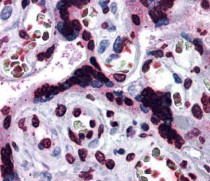
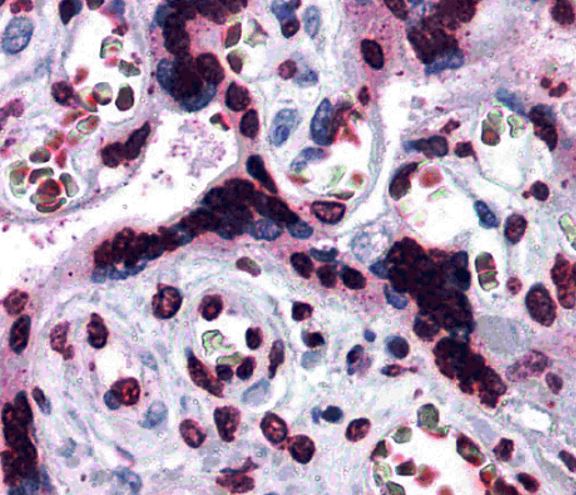
ARG46062 anti-CARD14 antibody IHC-P image
Immunohistochemistry: Human placenta stained with ARG46062 anti-CARD14 antibody.