ARG46326
anti-CD271 / NGFR p75 antibody
anti-CD271 / NGFR p75 antibody for Western blot,ICC/IF and Human,Mouse
Overview
| Product Description | Rabbit Polyclonal antibody recognizes CD271 / NGFR p75 |
|---|---|
| Tested Reactivity | Hu, Ms |
| Tested Application | ICC/IF, WB |
| Host | Rabbit |
| Clonality | Polyclonal |
| Isotype | IgG |
| Target Name | CD271 / NGFR p75 |
| Antigen Species | Human |
| Immunogen | Recombinant protein corresponding to human CD271 / NGFR p75. |
| Conjugation | Un-conjugated |
| Alternate Names | NGFR; Gp80-LNGFR; CD271; CD antigen CD271; p75 ICD; Tumor necrosis factor receptor superfamily member 16; p75NTR; NGF receptor; TNFRSF16; p75(NTR); Low affinity neurotrophin receptor p75NTR; Low-affinity nerve growth factor receptor |
Application Instructions
| Application Suggestion |
|
||||||
|---|---|---|---|---|---|---|---|
| Application Note | * The dilutions indicate recommended starting dilutions and the optimal dilutions or concentrations should be determined by the scientist. |
Properties
| Purification | Purification with Protein A |
|---|---|
| Buffer | PBS and 0.02% Sodium azide. |
| Preservative | 0.02% Sodium azide |
| Concentration | 1 mg/ml |
| Storage Instruction | For continuous use, store undiluted antibody at 2-8°C for up to a week. For long-term storage, aliquot and store at -20°C. Storage in frost free freezers is not recommended. Avoid repeated freeze/thaw cycles. Suggest spin the vial prior to opening. The antibody solution should be gently mixed before use. |
| Note | For laboratory research only, not for drug, diagnostic or other use. |
Bioinformation
| Database Links |
Swiss-port # P08138 Human Tumor necrosis factor receptor superfamily member 16 |
|---|---|
| Gene Symbol | NGFR |
| Gene Full Name | nerve growth factor receptor |
| Background | Nerve growth factor receptor contains an extracellular domain containing four 40-amino acid repeats with 6 cysteine residues at conserved positions followed by a serine/threonine-rich region, a single transmembrane domain, and a 155-amino acid cytoplasmic domain. The cysteine-rich region contains the nerve growth factor binding domain. [provided by RefSeq, Jul 2008] |
| Function | Plays a role in the regulation of the translocation of GLUT4 to the cell surface in adipocytes and skeletal muscle cells in response to insulin, probably by regulating RAB31 activity, and thereby contributes to the regulation of insulin-dependent glucose uptake (By similarity). Low affinity receptor which can bind to NGF, BDNF, NT-3, and NT-4. Can mediate cell survival as well as cell death of neural cells. Necessary for the circadian oscillation of the clock genes ARNTL/BMAL1, PER1, PER2 and NR1D1 in the suprachiasmatic nucleus (SCN) of the brain and in liver and of the genes involved in glucose and lipid metabolism in the liver. [UniProt] |
| Cellular Localization | Membrane; Single-pass type I membrane protein. [UniProt] |
| Calculated MW | 45 kDa |
| PTM | N- and O-glycosylated. O-linked glycans consist of Gal(1-3)GalNAc core elongated by 1 or 2 NeuNAc. Phosphorylated on serine residues. [UniProt] |
Images (2) Click the Picture to Zoom In
-
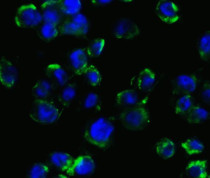
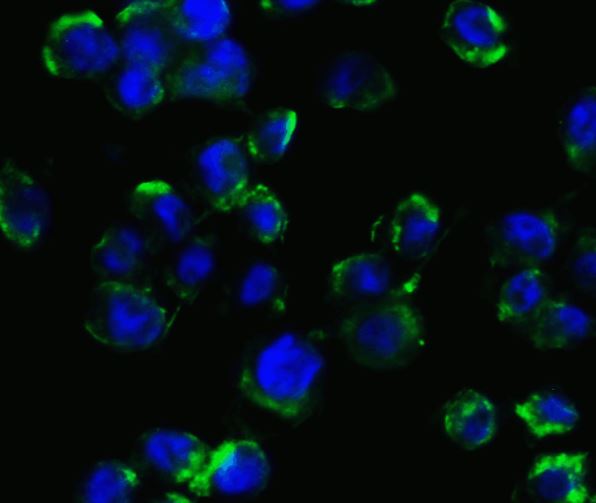
ARG46326 anti-CD271 / NGFR p75 antibody ICC/IF image
Immunofluorescence: HepG2 stained with ARG46326 anti-CD271 / NGFR p75 antibody.
-
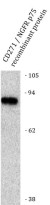
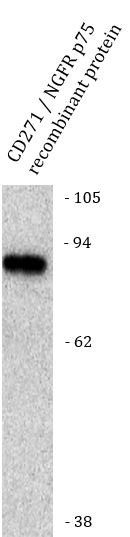
ARG46326 anti-CD271 / NGFR p75 antibody WB image
Western blot: CD271 / NGFR p75 recombinant protein stained with ARG46326 anti-CD271 / NGFR p75 antibody.