ARG46776
anti-CD274 / PD-L1 antibody [10F.9G2] (APC)
anti-CD274 / PD-L1 antibody [10F.9G2] (APC) for Flow cytometry and Mouse
Overview
| Product Description | APC-conjugated Rat Monoclonal antibody [10F.9G2] recognizes CD274 / PD-L1 |
|---|---|
| Tested Reactivity | Ms |
| Tested Application | FACS |
| Host | Rat |
| Clonality | Monoclonal |
| Clone | 10F.9G2 |
| Isotype | IgG2b kappa |
| Target Name | CD274 / PD-L1 |
| Conjugation | APC |
| Alternate Names | Programmed cell death 1 ligand 1; B7-H1; B7H1; PDL1; PDCD1 ligand 1; B7 homolog 1; PD-L1; CD antigen CD274; PDCD1L1; B7-H; Programmed death ligand 1; PDCD1LG1 |
Application Instructions
| Application Suggestion |
|
||||
|---|---|---|---|---|---|
| Application Note | * The dilutions indicate recommended starting dilutions and the optimal dilutions or concentrations should be determined by the scientist. |
Properties
| Form | Liquid |
|---|---|
| Purification | Affinity purification with immunogen |
| Buffer | PBS, 0.02% sodium azide and 0.2% BSA. |
| Preservative | 0.02% sodium azide |
| Stabilizer | 0.2% BSA |
| Storage Instruction | Aliquot and store in the dark at 2-8°C. Keep protected from prolonged exposure to light. Avoid repeated freeze/thaw cycles. Suggest spin the vial prior to opening. The antibody solution should be gently mixed before use. |
| Note | For laboratory research only, not for drug, diagnostic or other use. |
Bioinformation
| Database Links | |
|---|---|
| Gene Symbol | CD274 |
| Gene Full Name | CD274 molecule |
| Background | This gene encodes an immune inhibitory receptor ligand that is expressed by hematopoietic and non-hematopoietic cells, such as T cells and B cells and various types of tumor cells. The encoded protein is a type I transmembrane protein that has immunoglobulin V-like and C-like domains. Interaction of this ligand with its receptor inhibits T-cell activation and cytokine production. During infection or inflammation of normal tissue, this interaction is important for preventing autoimmunity by maintaining homeostasis of the immune response. In tumor microenvironments, this interaction provides an immune escape for tumor cells through cytotoxic T-cell inactivation. Expression of this gene in tumor cells is considered to be prognostic in many types of human malignancies, including colon cancer and renal cell carcinoma. Alternative splicing results in multiple transcript variants. [provided by RefSeq, Sep 2015] |
| Function | Involved in the costimulatory signal, essential for T-cell proliferation and production of IL10 and IFNG, in an IL2-dependent and a PDCD1-independent manner. Interaction with PDCD1 inhibits T-cell proliferation and cytokine production. [UniProt] |
| Cellular Localization | Cell membrane and Endomembrane system. |
| Calculated MW | 33 kDa |
Images (1) Click the Picture to Zoom In
-
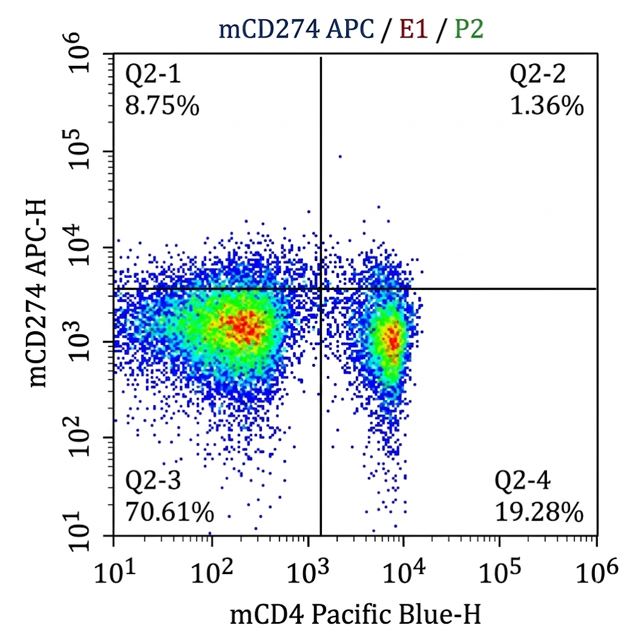
ARG46776 anti-CD274 / PD-L1 antibody [10F.9G2] (APC) FACS image
Flow Cytometry: Mouse spleen stained with ARG46776 anti-CD274 / PD-L1 antibody [10F.9G2] (APC).