ARG46098
anti-CRB2 antibody
anti-CRB2 antibody for Western blot and Human,Mouse,Rat
Overview
| Product Description | Rabbit Polyclonal antibody recognizes CRB2 |
|---|---|
| Tested Reactivity | Hu, Ms, Rat |
| Tested Application | WB |
| Host | Rabbit |
| Clonality | Polyclonal |
| Isotype | IgG |
| Target Name | CRB2 |
| Antigen Species | Human |
| Immunogen | A 17 amino acid synthetic peptide within aa. 460 - 510 of human CRB2. |
| Conjugation | Un-conjugated |
| Alternate Names | crumbs homolog 2 (Drosophila); CRB2; Protein crumbs homolog 2; Crumbs-like protein 2 |
Application Instructions
| Application Suggestion |
|
||||
|---|---|---|---|---|---|
| Application Note | * The dilutions indicate recommended starting dilutions and the optimal dilutions or concentrations should be determined by the scientist. | ||||
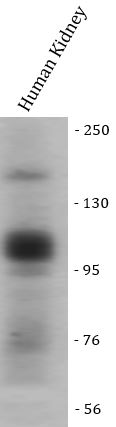
| Observed Size | 103,128 kDa |
Properties
| Form | Liquid |
|---|---|
| Purification | Affinity chromatography purified |
| Buffer | PBS and 0.02% Sodium azide. |
| Preservative | 0.02% Sodium azide |
| Concentration | 1 mg/ml |
| Storage Instruction | For continuous use, store undiluted antibody at 2-8°C for up to a week. For long-term storage, aliquot and store at -148°C or below. Storage in frost free freezers is not recommended. Avoid repeated freeze/thaw cycles. Suggest spin the vial prior to opening. The antibody solution should be gently mixed before use. |
| Note | For laboratory research only, not for drug, diagnostic or other use. |
Bioinformation
| Database Links | |
|---|---|
| Gene Symbol | CRB2 |
| Gene Full Name | crumbs homolog 2 (Drosophila) |
| Background | This gene encodes a member of a family of proteins that are components of the Crumbs cell polarity complex. In mammals, members of this family are thought to play a role in many cellular processes in early embryonic development. A similar protein in Drosophila determines apicobasal polarity in embryonic epithelial cells. Mutations in this gene are associated with focal segmental glomerulosclerosis 9, and with ventriculomegaly with cystic kidney disease. [provided by RefSeq, Aug 2016] |
| Function | Apical polarity protein that plays a central role during the epithelial-to-mesenchymal transition (EMT) at gastrulation, when newly specified mesodermal cells move inside the embryo (By similarity). Acts by promoting cell ingression, the process by which cells leave the epithelial epiblast and move inside the embryo to form a new tissue layer (By similarity). The anisotropic distribution of CRB2 and MYH10/myosin-IIB at cell edges define which cells will ingress: cells with high apical CRB2 are probably extruded from the epiblast by neighboring cells with high levels of apical MYH10/myosin-IIB (By similarity). Plays a role in the maintenance of retinal neuroepithelium organization, structural integrity, adhesion, photoreceptor polarity and retinal photoreceptor layer thickness (By similarity). May play a role in determining the length of cone photoreceptor outer segments and proliferation of late-born progenitor cells (By similarity). Also required for maintenance of the apical polarity complex during development of the cortex (By similarity). Inhibits gamma-secretase-dependent cleavage of APP and secretion of amyloid-beta peptide 40 and amyloid-beta peptide 42, and thereby inhibits gamma-secretase-dependent Notch transcription. [UniProt] |
| Cellular Localization | Secreted ; Cytoplasm; Apical cell membrane . [UniProt] |
| Calculated MW | 105,129,and141 kDa |
| PTM | Disulfide bond; Glycoprotein. [UniProt] |
Images (1) Click the Picture to Zoom In
-
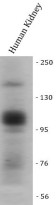
ARG46098 anti-CRB2 antibody WB image
Western blot: Human kidney stained with ARG46098 anti-CRB2 antibody.