ARG46821
anti-CXCL13 / BCA1 antibody
anti-CXCL13 / BCA1 antibody for Flow cytometry,IHC-Formalin-fixed paraffin-embedded sections,Western blot and Human
Overview
| Product Description | Rabbit Polyclonal antibody recognizes CXCL13 / BCA1 |
|---|---|
| Tested Reactivity | Hu |
| Tested Application | FACS, IHC-P, WB |
| Host | Rabbit |
| Clonality | Polyclonal |
| Isotype | IgG |
| Target Name | CXCL13 / BCA1 |
| Antigen Species | Human |
| Immunogen | A synthetic peptide corresponding to a sequence at the C-terminus of human CXCL13 / BCA1. |
| Conjugation | Un-conjugated |
| Alternate Names | BCA-1; Angie; C-X-C motif chemokine 13; CXC chemokine BLC; ANGIE2; B lymphocyte chemoattractant; B cell-attracting chemokine 1; BLR1L; Small-inducible cytokine B13; SCYB13; ANGIE; BLC; BCA1 |
Application Instructions
| Application Suggestion |
|
||||||||
|---|---|---|---|---|---|---|---|---|---|
| Application Note | * The dilutions indicate recommended starting dilutions and the optimal dilutions or concentrations should be determined by the scientist. | ||||||||
| Observed Size | 9 kDa |
Properties
| Form | Liquid |
|---|---|
| Purification | Affinity purification with immunogen |
| Purification Note | 4% Trehalose, 0.9% NaCl, 0.2% Na2HPO4 |
| Buffer | 4% Trehalose |
| Storage Instruction | For continuous use, store undiluted antibody at 2-8°C for up to a week. For long-term storage, aliquot and store at -20°C or below. Storage in frost free freezers is not recommended. Avoid repeated freeze/thaw cycles. Suggest spin the vial prior to opening. The antibody solution should be gently mixed before use. |
| Note | For laboratory research only, not for drug, diagnostic or other use. |
Bioinformation
| Database Links | |
|---|---|
| Gene Symbol | CXCL13 |
| Gene Full Name | C-X-C Motif Chemokine Ligand 13 |
| Background | B lymphocyte chemoattractant, independently cloned and named Angie, is an antimicrobial peptide and CXC chemokine strongly expressed in the follicles of the spleen, lymph nodes, and Peyer's patches. It preferentially promotes the migration of B lymphocytes (compared to T cells and macrophages), apparently by stimulating calcium influx into, and chemotaxis of, cells expressing Burkitt's lymphoma receptor 1 (BLR-1). It may therefore function in the homing of B lymphocytes to follicles. [provided by RefSeq, Oct 2014] |
| Function | Chemotactic for B-lymphocytes but not for T-lymphocytes, monocytes and neutrophils. Does not induce calcium release in B-lymphocytes. Binds to BLR1/CXCR5. [UniProt] |
| Cellular Localization | Secreted. [UniProt] |
| Calculated MW | 12.7 kDa |
| PTM | Disulfide bond. [UniProt] |
Images (3) Click the Picture to Zoom In
-
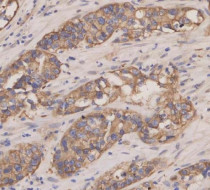
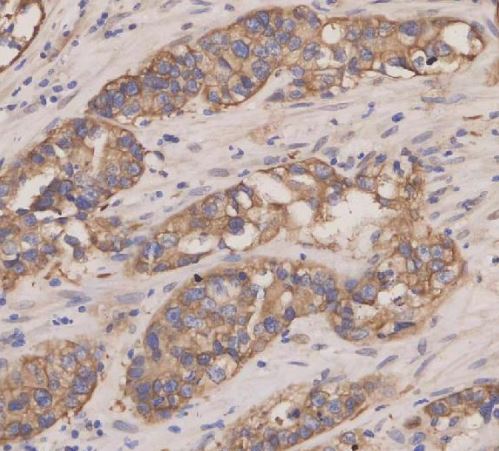
ARG46821 anti-CXCL13 / BCA1 antibody IHC-P image
Immunohistochemistry: Human appendiceal adenocarcinoma stained with ARG46821 anti-CXCL13 / BCA1 antibody.
-
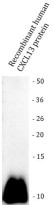
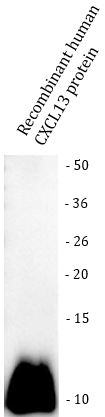
ARG46821 anti-CXCL13 / BCA1 antibody WB image
Western blot: Recombinant human CXCL13 protein stained with ARG46821 anti-CXCL13 / BCA1 antibody.
-
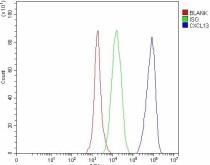
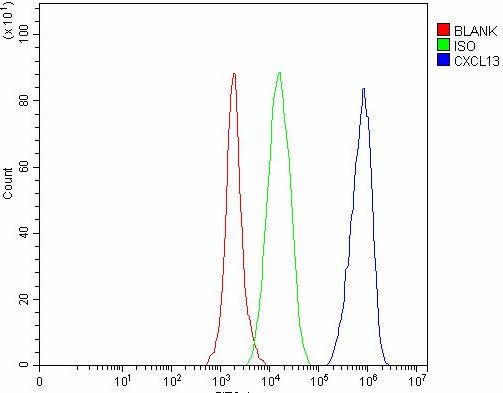
ARG46821 anti-CXCL13 / BCA1 antibody FACS image
Flow Cytometry: SH-SY5Y stained with ARG46821 anti-CXCL13 / BCA1 antibody.