ARG46817
anti-CXCR4 antibody
anti-CXCR4 antibody for Western blot and Human
Overview
| Product Description | Goat Polyclonal antibody recognizes CXCR4 |
|---|---|
| Tested Reactivity | Hu |
| Tested Application | WB |
| Host | Goat |
| Clonality | Polyclonal |
| Isotype | IgG |
| Target Name | CXCR4 |
| Antigen Species | Human |
| Immunogen | Recombinant peptide derived from within residues 310 aa to the C-terminus of human NPY3R produced in E. coli. |
| Conjugation | Un-conjugated |
| Alternate Names | SDF-1 Receptor; CD184 Antigen; LESTR; LAP-3; Fusin; NPYRL; HM89; FB22; C-X-C Chemokine Receptor Type 4; LCR1; D2S201E; Seven-Transmembrane-Segment Receptor, Spleen; NPYY3R; Chemokine (C-X-C Motif), Receptor 4 (Fusin); HSY3RR; Seven Transmembrane Helix Receptor; NPY3R; Neuropeptide Y Receptor Y3; CD184; Neuropeptide Y3 Receptor; NPYR; Chemokine Receptor 4; Leukocyte-Derived Seven Transmembrane Domain Receptor; WHIMS1; Lipopolysaccharide-Associated Protein 3; Stromal Cell-Derived Factor 1 Receptor; CXC-R4; Chemokine (C-X-C Motif) Receptor 4; WHIMS; LPS-Associated Protein 3; WHIM |
Application Instructions
| Application Suggestion |
|
||||
|---|---|---|---|---|---|
| Application Note | * The dilutions indicate recommended starting dilutions and the optimal dilutions or concentrations should be determined by the scientist. |
Properties
| Form | Liquid |
|---|---|
| Purification | Epitope affinity purified |
| Buffer | PBS, 20% Glycerol and 0.05% Sodium Azide |
| Preservative | 0.05% Sodium Azide |
| Stabilizer | 20% Glycerol |
| Concentration | 3 mg/ml |
| Storage Instruction | For continuous use, store at 2-8 C for one-two days. For extended storage, store in -20 C freezer. Working dilution samples should be discarded if not used within 12 hours. The antibody solution should be gently mixed before use. |
| Note | For laboratory research only, not for drug, diagnostic or other use. |
Bioinformation
| Database Links | |
|---|---|
| Gene Symbol | CXCR4 |
| Gene Full Name | C-X-C chemokine receptor |
| Background | This gene encodes a CXC chemokine receptor specific for stromal cell-derived factor-1. The protein has 7 transmembrane regions and is located on the cell surface. It acts with the CD4 protein to support HIV entry into cells and is also highly expressed in breast cancer cells. Mutations in this gene have been associated with WHIM (warts, hypogammaglobulinemia, infections, and myelokathexis) syndrome. Alternate transcriptional splice variants, encoding different isoforms, have been characterized. [provided by RefSeq, Jul 2008] |
| Function | Receptor for the C-X-C chemokine CXCL12/SDF-1 that transduces a signal by increasing intracellular calcium ion levels and enhancing MAPK1/MAPK3 activation. Ligand binding causes a conformation change that triggers signaling via G proteins, modulating the activity of downstream effectors such as adenylate cyclase. Coupled to G(i) proteins, mediating inhibition of adenylate cyclase. Involved in the AKT signaling cascade and the regulation of cell migration. Also acts as a receptor for extracellular ubiquitin and binds bacterial lipopolysaccharide (LPS), mediating LPS-induced inflammatory responses. Acts as a coreceptor (CD4 being the primary receptor) for HIV-1 X4 isolates. [UniProt] |
| Cellular Localization | Cell membrane; Cytoplasmic vesicle; Early endosome; Late endosome; Lysosome. [UniProt] |
| Calculated MW | 39.7 kDa |
| PTM | Disulfide bond; Glycoprotein; Phosphoprotein; Sulfation; Ubl conjugation. [UniProt] |
Images (1) Click the Picture to Zoom In
-
ARG46817 anti-CXCR4 antibody WB image
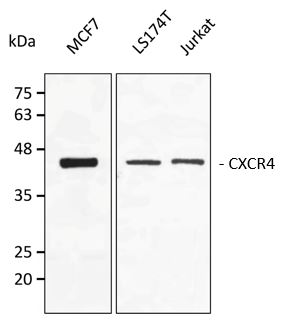
Western blot: MCF7, LS174T and Jurkat stained with ARG46817 anti-CXCR4 antibody.