ARG46735
anti-Cav 1.3 antibody
anti-Cav 1.3 antibody for Western blot and Human,Mouse,Rat
Overview
| Product Description | Rabbit Polyclonal antibody recognizes Cav 1.3 |
|---|---|
| Tested Reactivity | Hu, Ms, Rat |
| Tested Application | WB |
| Host | Rabbit |
| Clonality | Polyclonal |
| Isotype | IgG |
| Target Name | Cav 1.3 |
| Immunogen | E.coli expressed protein |
| Conjugation | Un-conjugated |
| Alternate Names | SANDD; CCHL1A2; Cav1.3; CACN4; PASNA; CACNL1A2; Calcium channel, L type, alpha-1 polypeptide, isoform 2; Voltage-dependent L-type calcium channel subunit alpha-1D; CACH3; Voltage-gated calcium channel subunit alpha Cav1.3 |
Application Instructions
| Application Suggestion |
|
||||
|---|---|---|---|---|---|
| Application Note | * The dilutions indicate recommended starting dilutions and the optimal dilutions or concentrations should be determined by the scientist. | ||||
| Observed Size | 245 kDa |
Properties
| Form | Liquid |
|---|---|
| Purification | Affinity chromatography purified |
| Buffer | 0.9% NaCl, 0.2% Na2HPO4 and 0.05% Sodium azide |
| Preservative | 0.05% Sodium azide |
| Storage Instruction | For continuous use, store undiluted antibody at 2-8°C for up to a week. For long-term storage, aliquot and store at -20°C or below. Storage in frost free freezers is not recommended. Avoid repeated freeze/thaw cycles. Suggest spin the vial prior to opening. The antibody solution should be gently mixed before use. |
| Note | For laboratory research only, not for drug, diagnostic or other use. |
Bioinformation
| Database Links | |
|---|---|
| Gene Symbol | Cacna1d |
| Gene Full Name | calcium channel, voltage-dependent, L type, alpha 1D subunit |
| Background | Voltage-dependent calcium channels mediate the entry of calcium ions into excitable cells, and are also involved in a variety of calcium-dependent processes, including muscle contraction, hormone or neurotransmitter release, and gene expression. Calcium channels are multisubunit complexes composed of alpha-1, beta, alpha-2/delta, and gamma subunits. The channel activity is directed by the pore-forming alpha-1 subunit, whereas the others act as auxiliary subunits regulating this activity. The distinctive properties of the calcium channel types are related primarily to the expression of a variety of alpha-1 isoforms, namely alpha-1A, B, C, D, E, and S. This gene encodes the alpha-1D subunit. Several transcript variants encoding different isoforms have been found for this gene. [provided by RefSeq, Dec 2012] |
| Function | Voltage-sensitive calcium channels (VSCC) mediate the entry of calcium ions into excitable cells and are also involved in a variety of calcium-dependent processes, including muscle contraction, hormone or neurotransmitter release, gene expression, cell motility, cell division and cell death. The isoform alpha-1D gives rise to L-type calcium currents. Long-lasting (L-type) calcium channels belong to the 'high-voltage activated' (HVA) group. They are blocked by dihydropyridines (DHP), phenylalkylamines, benzothiazepines, and by omega-agatoxin-IIIA (omega-Aga-IIIA). They are however insensitive to omega-conotoxin-GVIA (omega-CTx-GVIA) and omega-agatoxin-IVA (omega-Aga-IVA). [UniProt] |
| Cellular Localization | Cell membrane, Membrane |
| Calculated MW | 245 kDa |
Images (2) Click the Picture to Zoom In
-
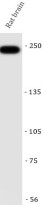
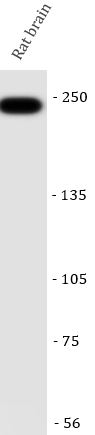
ARG46735 anti-Cav 1.3 antibody WB image
Western blot: Rat Brain stained with ARG46735 anti-Cav 1.3 antibody.
-
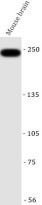
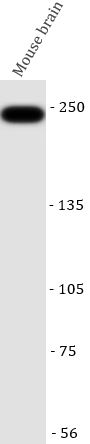
ARG46735 anti-Cav 1.3 antibody WB image
Western blot: Mouse Brain stained with ARG46735 anti-Cav 1.3 antibody.