ARG46829
anti-DAB2 antibody
anti-DAB2 antibody for Flow cytometry,ICC/IF,IHC-Formalin-fixed paraffin-embedded sections,Western blot and Human,Monkey,Mouse,Rat
Overview
| Product Description | Rabbit Polyclonal antibody recognizes DAB2 |
|---|---|
| Tested Reactivity | Hu, Ms, Rat, Mk |
| Tested Application | FACS, ICC/IF, IHC-P, WB |
| Host | Rabbit |
| Clonality | Polyclonal |
| Isotype | IgG |
| Target Name | DAB2 |
| Antigen Species | Human |
| Immunogen | Recombinant protein within a.a. H89-A770 of human DAB2. |
| Conjugation | Un-conjugated |
| Alternate Names | DAB2; Disabled Homolog 2; Name: DAB Adaptor Protein 2; DOC2; DOC-2; Disabled (Drosophila) Homolog 2 (Mitogen-Responsive Phosphoprotein); Differentially Expressed In Ovarian Carcinoma 2; Disabled Homolog 2, Mitogen-Responsive Phosphoprotein (Drosophila); Differentially-Expressed Protein 2; Dab, Mitogen-Responsive Phosphoprotein, Homolog 2 (Drosophila); DAB2, Clathrin Adaptor Protein; Disabled Homolog 2, Mitogen-Responsive Phosphoprotein; Adaptor Molecule Disabled-2; Dab, Mitogen-Responsive Phosphoprotein, Homolog 2; Database Identifiers for DAB2 |
Application Instructions
| Application Suggestion |
|
||||||||||
|---|---|---|---|---|---|---|---|---|---|---|---|
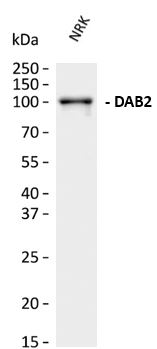
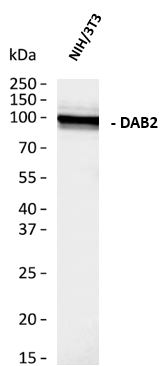
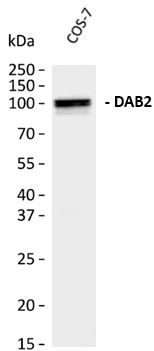
| Observed Size | 95 kDa |
Properties
| Form | Liquid |
|---|---|
| Purification | Affinity chromatography purified |
| Buffer | 0.9% NaCl, 0.2% Na2HPO4 |
| Stabilizer | 4 mg Trehalose |
| Storage Instruction | For continuous use, store undiluted antibody at 2-8°C for up to a week. For long-term storage, aliquot and store at -20°C or below. Storage in frost free freezers is not recommended. Avoid repeated freeze/thaw cycles. Suggest spin the vial prior to opening. The antibody solution should be gently mixed before use. |
| Note | For laboratory research only, not for drug, diagnostic or other use. |
Bioinformation
| Database Links | |
|---|---|
| Gene Symbol | DAB2 |
| Gene Full Name | DAB Adaptor Protein 2 |
| Background | This gene encodes a mitogen-responsive phosphoprotein. It is expressed in normal ovarian epithelial cells, but is down-regulated or absent from ovarian carcinoma cell lines, suggesting its role as a tumor suppressor. This protein binds to the SH3 domains of GRB2, an adaptor protein that couples tyrosine kinase receptors to SOS (a guanine nucleotide exchange factor for Ras), via its C-terminal proline-rich sequences, and may thus modulate growth factor/Ras pathways by competing with SOS for binding to GRB2. Alternatively spliced transcript variants encoding different isoforms have been found for this gene. [provided by RefSeq, Oct 2011] |
| Function | Adapter protein that functions as a clathrin-associated sorting protein (CLASP) required for clathrin-mediated endocytosis of selected cargo proteins. Can bind and assemble clathrin, and binds simultaneously to phosphatidylinositol 4,5-bisphosphate (PtdIns(4,5)P2) and cargos containing non-phosphorylated NPXY internalization motifs, such as the LDL receptor, to recruit them to clathrin-coated pits. Can function in clathrin-mediated endocytosis independently of the AP-2 complex. Involved in endocytosis of integrin beta-1; this function seems to redundant with the AP-2 complex and seems to require DAB2 binding to endocytosis accessory EH domain-containing proteins such as EPS15, EPS15L1 and ITSN1. Involved in endocytosis of cystic fibrosis transmembrane conductance regulator/CFTR. Involved in endocytosis of megalin/LRP2 lipoprotein receptor during embryonal development. Required for recycling of the TGF-beta receptor. Involved in CFTR trafficking to the late endosome. Involved in several receptor-mediated signaling pathways. Involved in TGF-beta receptor signaling and facilitates phosphorylation of the signal transducer SMAD2. Mediates TFG-beta-stimulated JNK activation. May inhibit the canoniocal Wnt/beta-catenin signaling pathway by stabilizing the beta-catenin destruction complex through a competing association with axin preventing its dephosphorylation through protein phosphatase 1 (PP1). Sequesters LRP6 towards clathrin-mediated endocytosis, leading to inhibition of Wnt/beta-catenin signaling. May activate non-canonical Wnt signaling. In cell surface growth factor/Ras signaling pathways proposed to inhibit ERK activation by interrupting the binding of GRB2 to SOS1 and to inhibit SRC by preventing its activating phosphorylation at 'Tyr-419'. Proposed to be involved in modulation of androgen receptor (AR) signaling mediated by SRC activation; seems to compete with AR for interaction with SRC. Plays a role in the CSF-1 signal transduction pathway. Plays a role in cellular differentiation. Involved in cell positioning and formation of visceral endoderm (VE) during embryogenesis and proposed to be required in the VE to respond to Nodal signaling coming from the epiblast. Required for the epithelial to mesenchymal transition, a process necessary for proper embryonic development. May be involved in myeloid cell differentiation and can induce macrophage adhesion and spreading. May act as a tumor suppressor. |
| Cellular Localization | Coated pit; Cytoplasm; Cytoplasmic vesicle; Membrane. [UniProt] |
| Calculated MW | 82 kDa |
| PTM | Acetylation; Phosphoprotein. [UniProt] |
Images (7) Click the Picture to Zoom In
-
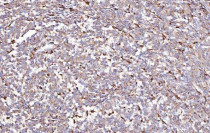
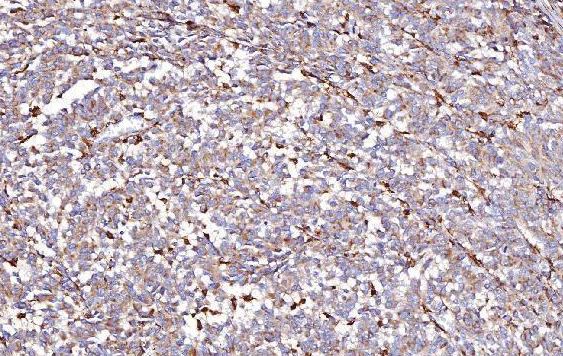
ARG46829 anti-DAB2 antibody IHC-P image
Immunohistochemistry: Human melanoma stained with ARG46829 anti-DAB2 antibody at 2 ug/mL dilution.
-
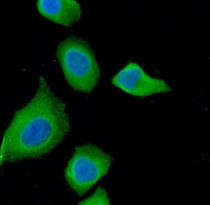
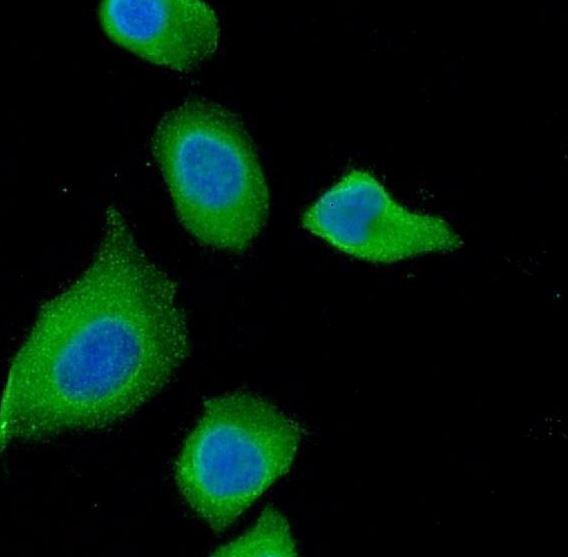
ARG46829 anti-DAB2 antibody ICC/IF image
Immunofluorescence: Hela stained with ARG46829 anti-DAB2 antibody at 5 ug/mL dilution.
-
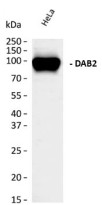
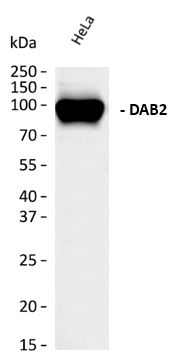
ARG46829 anti-DAB2 antibody WB image
Western blot: Hela stained with ARG46829 anti-DAB2 antibody at 0.5 ug/mL dilution.
-
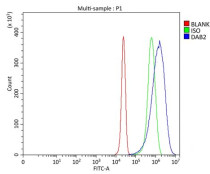
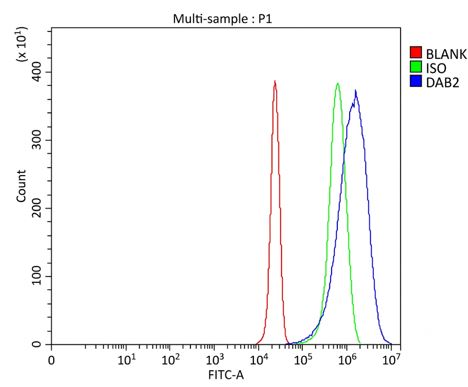
ARG46829 anti-DAB2 antibody FACS image
Flow Cytometry: HepG2 stained with ARG46829 anti-DAB2 antibody.
-
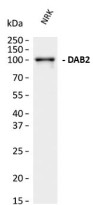
ARG46829 anti-DAB2 antibody WB image
Western blot: NRK stained with ARG46829 anti-DAB2 antibody at 0.5 ug/mL dilution.
-
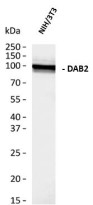
ARG46829 anti-DAB2 antibody WB image
Western blot: NIH/3T3 stained with ARG46829 anti-DAB2 antibody at 0.5 ug/mL dilution.
-
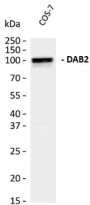
ARG46829 anti-DAB2 antibody WB image
Western blot: COS-7 stained with ARG46829 anti-DAB2 antibody at 0.5 ug/mL dilution.