ARG46553
anti-DCAF12 antibody
anti-DCAF12 antibody for Western blot and Human,Mouse,Rat
Overview
| Product Description | Chicken Polyclonal antibody recognizes DCAF12 |
|---|---|
| Tested Reactivity | Hu, Ms, Rat |
| Tested Application | WB |
| Host | Chicken |
| Clonality | Polyclonal |
| Isotype | IgY |
| Target Name | DCAF12 |
| Antigen Species | Human |
| Immunogen | A 15 amino acid synthetic peptide within the last 50 amino acids of human DCAF12. |
| Conjugation | Un-conjugated |
| Alternate Names | DCAF12; DDB1 and CUL4 associated factor 12; TCC52; CT102; TCC52; WDR40A; KIAA1892; DDB1- and CUL4-associated factor 12; Centrosome-related protein TCC52 |
Application Instructions
| Application Suggestion |
|
||||
|---|---|---|---|---|---|
| Application Note | * The dilutions indicate recommended starting dilutions and the optimal dilutions or concentrations should be determined by the scientist. |
Properties
| Form | Liquid |
|---|---|
| Purification | Affinity chromatography purified |
| Buffer | PBS and 0.02% Sodium azide. |
| Preservative | 0.02% Sodium azide |
| Concentration | 1 mg/ml |
| Storage Instruction | For continuous use, store undiluted antibody at 2-8°C for up to a week. For long-term storage, aliquot and store at -603°C or below. Storage in frost free freezers is not recommended. Avoid repeated freeze/thaw cycles. Suggest spin the vial prior to opening. The antibody solution should be gently mixed before use. |
| Note | For laboratory research only, not for drug, diagnostic or other use. |
Bioinformation
| Database Links |
Swiss-port # Q5T6F0 Human DDB1- and CUL4-associated factor 12 Swiss-port # Q8BGZ3 Mouse DDB1- and CUL4-associated factor 12 |
|---|---|
| Gene Symbol | DCAF12 |
| Gene Full Name | DDB1 and CUL4 associated factor 12 |
| Background | This gene encodes a WD repeat-containing protein that interacts with the COP9 signalosome, a macromolecular complex that interacts with cullin-RING E3 ligases and regulates their activity by hydrolyzing cullin-Nedd8 conjugates. [provided by RefSeq, Jul 2009] |
| Function | Substrate-recognition component of a DCX (DDB1-CUL4-X-box) E3 ubiquitin-protein ligase complex of the DesCEND (destruction via C-end degrons) pathway, which recognizes a C-degron located at the extreme C terminus of target proteins, leading to their ubiquitination and degradation (PubMed:16949367, PubMed:16964240, PubMed:29779948). The C-degron recognized by the DesCEND pathway is usually a motif of less than ten residues and can be present in full-length proteins, truncated proteins or proteolytically cleaved forms (PubMed:29779948). The DCX(DCAF12) complex specifically recognizes proteins with a diglutamate (Glu-Glu) at the C-terminus, such as MAGEA3, MAGEA6 and CCT5, leading to their ubiquitination and degradation (PubMed:29779948, PubMed:31267705). Ubiquitination of MAGEA3, MAGEA6 by DCX(DCAF12) complex is required for starvation-induced autophagy (PubMed:31267705). Also directly recognizes the C-terminal glutamate-leucine (Glu-Leu) degron as an alternative degron in proteins such as MOV10, leading to their ubiquitination and degradation. Controls the protein level of MOV10 during spermatogenesis and in T cells, especially after their activation (PubMed:34065512). [UniProt] |
| Cellular Localization | Cytoplasm; Nucleus; Cytoskeleton. [UniProt] |
| Calculated MW | 51 kDa |
| PTM | Phosphoprotein; Ubl conjugation. [UniProt] |
Images (1) Click the Picture to Zoom In
-
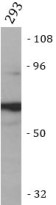
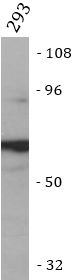
ARG46553 anti-DCAF12 antibody WB image
Western blot: 293 stained with ARG46553 anti-DCAF12 antibody.