ARG65651
anti-DMTF1 antibody
anti-DMTF1 antibody for Western blot and Human,Mouse,Rat
Cell Biology and Cellular Response antibody; Gene Regulation antibody
Overview
| Product Description | Goat Polyclonal antibody recognizes DMTF1 |
|---|---|
| Tested Reactivity | Hu, Ms, Rat |
| Predict Reactivity | Cow, Dog, Pig |
| Tested Application | WB |
| Specificity | This antibody is expected to recognize both reported isoforms (NP_066968.3; NP_001135798.1). |
| Host | Goat |
| Clonality | Polyclonal |
| Target Name | DMTF1 |
| Antigen Species | Human |
| Immunogen | Synthetic peptide around the internal region of Human DMTF1 (C-DAHVSKFSDQNSTE) |
| Conjugation | Un-conjugated |
| Alternate Names | hDMP1; hDMTF1; DMTF; Cyclin-D-binding Myb-like transcription factor 1; DMP1; MRUL; Cyclin-D-interacting Myb-like protein 1 |
Application Instructions
| Application Suggestion |
|
||||
|---|---|---|---|---|---|
| Application Note | WB: Recommend incubate at RT for 1h. * The dilutions indicate recommended starting dilutions and the optimal dilutions or concentrations should be determined by the scientist. |
Properties
| Form | Liquid |
|---|---|
| Purification | Affinity purified |
| Buffer | Tris saline (pH 7.3), 0.02% Sodium azide and 0.5% BSA. |
| Preservative | 0.02% Sodium azide |
| Stabilizer | 0.5% BSA |
| Concentration | 0.5 mg/ml |
| Storage Instruction | For continuous use, store undiluted antibody at 2-8°C for up to a week. For long-term storage, aliquot and store at -20°C or below. Storage in frost free freezers is not recommended. Avoid repeated freeze/thaw cycles. Suggest spin the vial prior to opening. The antibody solution should be gently mixed before use. |
| Note | For laboratory research only, not for drug, diagnostic or other use. |
Bioinformation
| Database Links | |
|---|---|
| Gene Symbol | DMTF1 |
| Gene Full Name | cyclin D binding myb-like transcription factor 1 |
| Background | This gene encodes a transcription factor that contains a cyclin D-binding domain, three central Myb-like repeats, and two flanking acidic transactivation domains at the N- and C-termini. The encoded protein is induced by the oncogenic Ras signaling pathway and functions as a tumor suppressor by activating the transcription of ARF and thus the ARF-p53 pathway to arrest cell growth or induce apoptosis. It also activates the transcription of aminopeptidase N and may play a role in hematopoietic cell differentiation. The transcriptional activity of this protein is regulated by binding of D-cyclins. This gene is hemizygously deleted in approximately 40% of human non-small-cell lung cancer and is a potential prognostic and gene-therapy target for non-small-cell lung cancer. Multiple transcript variants encoding different isoforms have been found for this gene. [provided by RefSeq, Dec 2008] |
| Function | Transcriptional activator which activates the CDKN2A/ARF locus in response to Ras-Raf signaling, thereby promoting p53/TP53-dependent growth arrest (By similarity). Binds to the consensus sequence 5'-CCCG[GT]ATGT-3' (By similarity). Isoform 1 may cooperate with MYB to activate transcription of the ANPEP gene. Isoform 2 may antagonize transcriptional activation by isoform 1. [UniProt] |
| Research Area | Cell Biology and Cellular Response antibody; Gene Regulation antibody |
| Calculated MW | 75 kDa (NP_001135799.1) |
| PTM | Phosphorylated by the cyclin-D2/CDK4, cyclin-D3/CDK4 and cyclin-D2/CDK6 complexes and to a lesser extent by the cyclin-D1/CDK4 complex. |
Images (1) Click the Picture to Zoom In
-
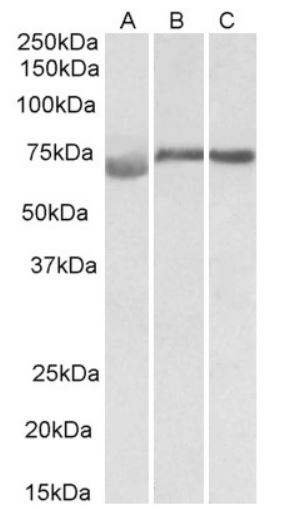
ARG65651 anti-DMTF1 antibody WB image
Western blot: 35 μg of Human (A), Mouse (B) and Rat (C) Testis lysate stained with ARG65651 anti-DMTF1 antibody at 1 μg/ml dilution (1 hour incubation).