ARG46131
anti-DPF3 antibody
anti-DPF3 antibody for Western blot,IHC-Formalin-fixed paraffin-embedded sections and Human,Mouse
Overview
| Product Description | Rabbit Polyclonal antibody recognizes DPF3 |
|---|---|
| Tested Reactivity | Hu, Ms |
| Tested Application | IHC-P, WB |
| Host | Rabbit |
| Clonality | Polyclonal |
| Isotype | IgG |
| Target Name | DPF3 |
| Antigen Species | Human |
| Immunogen | A 18 amino acid synthetic peptide within aa. 220 - 270 of human DPF3. |
| Conjugation | Un-conjugated |
| Alternate Names | D4, zinc and double PHD fingers, family 3; DPF3; CERD4; BAF45C; CERD4; Zinc finger protein DPF3; BRG1-associated factor 45C |
Application Instructions
| Application Suggestion |
|
||||||
|---|---|---|---|---|---|---|---|
| Application Note | * The dilutions indicate recommended starting dilutions and the optimal dilutions or concentrations should be determined by the scientist. | ||||||
| Observed Size | 50 kDa |
Properties
| Form | Liquid |
|---|---|
| Purification | Affinity chromatography purified |
| Buffer | PBS and 0.02% Sodium azide. |
| Preservative | 0.02% Sodium azide |
| Concentration | 1 mg/ml |
| Storage Instruction | For continuous use, store undiluted antibody at 2-8°C for up to a week. For long-term storage, aliquot and store at -181°C or below. Storage in frost free freezers is not recommended. Avoid repeated freeze/thaw cycles. Suggest spin the vial prior to opening. The antibody solution should be gently mixed before use. |
| Note | For laboratory research only, not for drug, diagnostic or other use. |
Bioinformation
| Database Links | |
|---|---|
| Gene Symbol | DPF3 |
| Gene Full Name | D4, zinc and double PHD fingers, family 3 |
| Background | This gene encodes a member of the D4 protein family. The encoded protein is a transcription regulator that binds acetylated histones and is a component of the BAF chromatin remodeling complex. Alternate splicing results in multiple transcript variants encoding different isoforms. [provided by RefSeq, Jul 2013] |
| Function | Belongs to the neuron-specific chromatin remodeling complex (nBAF complex). During neural development a switch from a stem/progenitor to a post-mitotic chromatin remodeling mechanism occurs as neurons exit the cell cycle and become committed to their adult state. The transition from proliferating neural stem/progenitor cells to post-mitotic neurons requires a switch in subunit composition of the npBAF and nBAF complexes. As neural progenitors exit mitosis and differentiate into neurons, npBAF complexes which contain ACTL6A/BAF53A and PHF10/BAF45A, are exchanged for homologous alternative ACTL6B/BAF53B and DPF1/BAF45B or DPF3/BAF45C subunits in neuron-specific complexes (nBAF). The npBAF complex is essential for the self-renewal/proliferative capacity of the multipotent neural stem cells. The nBAF complex along with CREST plays a role regulating the activity of genes essential for dendrite growth (By similarity). Muscle-specific component of the BAF complex, a multiprotein complex involved in transcriptional activation and repression of select genes by chromatin remodeling (alteration of DNA-nucleosome topology). Specifically binds acetylated lysines on histone 3 and 4 (H3K14ac, H3K9ac, H4K5ac, H4K8ac, H4K12ac, H4K16ac). In the complex, it acts as a tissue-specific anchor between histone acetylations and methylations and chromatin remodeling. It thereby probably plays an essential role in heart and skeletal muscle development. {ECO:0000250, ECO:0000269|PubMed:18765789}.; [Isoform 2]: Acts as a regulator of myogenesis in cooperation with HDGFL2 (PubMed:32459350). Mediates the interaction of HDGFL2 with the BAF complex (PubMed:32459350). HDGFL2-DPF3a activate myogenic genes by increasing chromatin accessibility through recruitment of SMARCA4/BRG1/BAF190A (ATPase subunit of the BAF complex) to myogenic gene promoters (PubMed:32459350). {ECO:0000269|PubMed:32459350}. [UniProt] |
| Cellular Localization | Nucleus. [UniProt] |
| Calculated MW | 39 kDa |
| PTM | Phosphoprotein; Isopeptide bond. [UniProt] |
Images (2) Click the Picture to Zoom In
-
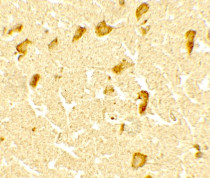
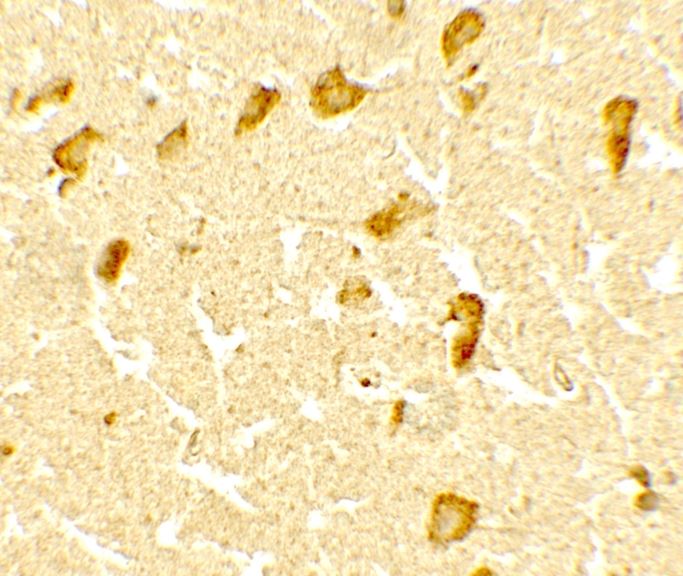
ARG46131 anti-DPF3 antibody IHC-P image
Immunohistochemistry: Human brain stained with ARG46131 anti-DPF3 antibody.
-
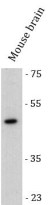
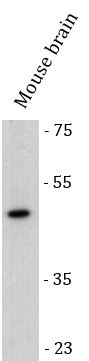
ARG46131 anti-DPF3 antibody WB image
Western blot: Mouse brain stained with ARG46131 anti-DPF3 antibody.