ARG46144
anti-EMX2 antibody
anti-EMX2 antibody for Western blot,IHC-Formalin-fixed paraffin-embedded sections and Human
Overview
| Product Description | Rabbit Polyclonal antibody recognizes EMX2 |
|---|---|
| Tested Reactivity | Hu |
| Tested Application | IHC-P, WB |
| Host | Rabbit |
| Clonality | Polyclonal |
| Isotype | IgG |
| Target Name | EMX2 |
| Antigen Species | Human |
| Immunogen | A 18 amino acid synthetic peptide within aa. 60 - 110 of human EMX2. |
| Conjugation | Un-conjugated |
| Alternate Names | empty spiracles homeobox 2; EMX2; Homeobox protein EMX2; Empty spiracles homolog 2 |
Application Instructions
| Application Suggestion |
|
||||||
|---|---|---|---|---|---|---|---|
| Application Note | * The dilutions indicate recommended starting dilutions and the optimal dilutions or concentrations should be determined by the scientist. |
Properties
| Form | Liquid |
|---|---|
| Purification | Affinity chromatography purified |
| Buffer | PBS and 0.02% Sodium azide. |
| Preservative | 0.02% Sodium azide |
| Concentration | 1 mg/ml |
| Storage Instruction | For continuous use, store undiluted antibody at 2-8°C for up to a week. For long-term storage, aliquot and store at -194°C or below. Storage in frost free freezers is not recommended. Avoid repeated freeze/thaw cycles. Suggest spin the vial prior to opening. The antibody solution should be gently mixed before use. |
| Note | For laboratory research only, not for drug, diagnostic or other use. |
Bioinformation
| Database Links | |
|---|---|
| Gene Symbol | EMX2 |
| Gene Full Name | empty spiracles homeobox 2 |
| Background | This gene encodes a homeobox-containing transcription factor that is the homolog to the 'empty spiracles' gene in Drosophila. Research on this gene in humans has focused on its expression in three tissues: dorsal telencephalon, olfactory neuroepithelium, and urogenetial system. It is expressed in the dorsal telencephalon during development in a low rostral-lateral to high caudal-medial gradient and is proposed to pattern the neocortex into defined functional areas. It is also expressed in embryonic and adult olfactory neuroepithelia where it complexes with eukaryotic translation initiation factor 4E (eIF4E) and possibly regulates mRNA transport or translation. In the developing urogenital system, it is expressed in epithelial tissues and is negatively regulated by HOXA10. Alternative splicing results in multiple transcript variants encoding distinct proteins.[provided by RefSeq, Sep 2009] |
| Function | Transcription factor, which in cooperation with EMX1, acts to generate the boundary between the roof and archipallium in the developing brain. May function in combination with OTX1/2 to specify cell fates in the developing central nervous system. In the inner ear, it controls the distribution of GPR156 at hair cell boundaries, and regulates the organization of stereociliary bundles in opposite orientations across the line of polarity reversal (LPR). [UniProt] |
| Cellular Localization | Nucleus; Cell projection. [UniProt] |
| Calculated MW | 28 kDa |
Images (2) Click the Picture to Zoom In
-
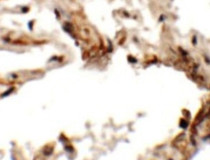
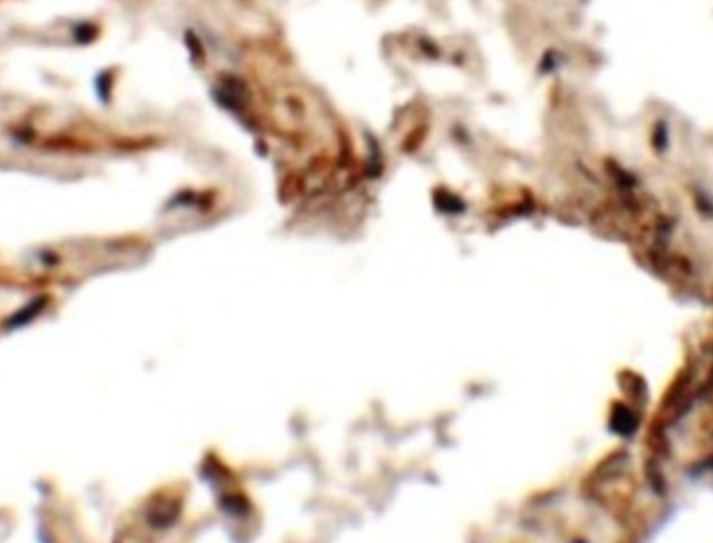
ARG46144 anti-EMX2 antibody IHC-P image
Immunohistochemistry: Human lung stained with ARG46144 anti-EMX2 antibody.
-
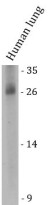
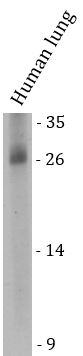
ARG46144 anti-EMX2 antibody WB image
Western blot: Human lung stained with ARG46144 anti-EMX2 antibody.