ARG45351
anti-Eph receptor B4 / HTK antibody [6A14]
anti-Eph receptor B4 / HTK antibody [6A14] for IHC-Formalin-fixed paraffin-embedded sections and Mouse
Overview
| Product Description | Rat Monoclonal antibody [6A14] recognizes Eph receptor B4 / HTK |
|---|---|
| Tested Reactivity | Ms |
| Tested Application | IHC-P |
| Host | Rat |
| Clonality | Monoclonal |
| Clone | 6A14 |
| Isotype | IgG1 |
| Target Name | Eph receptor B4 / HTK |
| Antigen Species | Mouse |
| Immunogen | Recombinant Mouse Eph receptor B4 / HTK. |
| Conjugation | Un-conjugated |
| Alternate Names | EPHB4; EPH Receptor B4; Tyro11; HTK; Tyrosine-Protein Kinase TYRO11; Hepatoma Transmembrane Kinase; Ephrin Type-B Receptor 4; EC 2.7.10.1; MYK1; Tyrosine-Protein Kinase Receptor HTK; Ephrin Receptor EphB4; EC 2.7.10; CMAVM2; LMPHM7; TYRO11; EphB4; HFASD |
Application Instructions
| Application Suggestion |
|
||||
|---|---|---|---|---|---|
| Application Note | * The dilutions indicate recommended starting dilutions and the optimal dilutions or concentrations should be determined by the scientist. |
Properties
| Form | Liquid |
|---|---|
| Purification | Protein G/A chromatography |
| Buffer | PBS |
| Concentration | 0.2 mg/ml |
| Storage Instruction | For continuous use, store undiluted antibody at 2-8°C for up to a week. For long-term storage, aliquot and store at -20°C or below. Storage in frost free freezers is not recommended. Avoid repeated freeze/thaw cycles. Suggest spin the vial prior to opening. The antibody solution should be gently mixed before use. |
| Note | For laboratory research only, not for drug, diagnostic or other use. |
Bioinformation
| Database Links | |
|---|---|
| Gene Symbol | EphB4 |
| Gene Full Name | EPH Receptor B4 |
| Background | Ephrin receptors and their ligands, the ephrins, mediate numerous developmental processes, particularly in the nervous system. Based on their structures and sequence relationships, ephrins are divided into the ephrin-A (EFNA) class, which are anchored to the membrane by a glycosylphosphatidylinositol linkage, and the ephrin-B (EFNB) class, which are transmembrane proteins. The Eph family of receptors are divided into 2 groups based on the similarity of their extracellular domain sequences and their affinities for binding ephrin-A and ephrin-B ligands. Ephrin receptors make up the largest subgroup of the receptor tyrosine kinase (RTK) family. The protein encoded by this gene binds to ephrin-B2 and plays an essential role in vascular development. [provided by RefSeq, Jul 2008] |
| Cellular Localization | Membrane . [UniProt] |
| Calculated MW | 110 kDa |
| PTM | Disulfide bondautomatic annotation; Glycoproteinautomatic annotation; Phosphoprotein. [UniProt] |
Images (1) Click the Picture to Zoom In
-
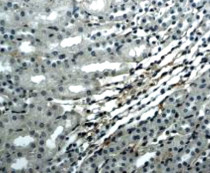
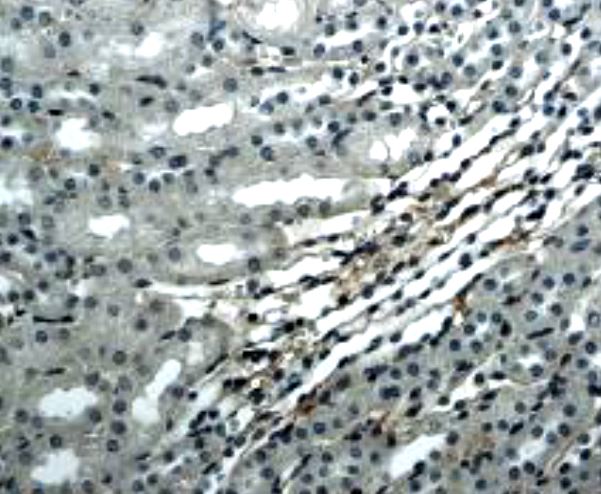
ARG45351 anti-Eph receptor B4 / HTK antibody [6A14] IHC-P image
Immunohistochemistry: Mouse kidney stained with ARG45351 anti-Eph receptor B4 / HTK antibody [6A14].