ARG46185
anti-GNPDA1 antibody
anti-GNPDA1 antibody for Western blot,ICC/IF and Human,Mouse,Rat
Overview
| Product Description | Rabbit Polyclonal antibody recognizes GNPDA1 |
|---|---|
| Tested Reactivity | Hu, Ms, Rat |
| Tested Application | ICC/IF, WB |
| Host | Rabbit |
| Clonality | Polyclonal |
| Isotype | IgG |
| Target Name | GNPDA1 |
| Antigen Species | Human |
| Immunogen | A 18 amino acid synthetic peptide within the last 50 amino acids of human GNPDA1. |
| Conjugation | Un-conjugated |
| Alternate Names | GNPDA1; GPI; HLN; GNP1; GNPI; GNPDA; KIAA0060; Glucosamine-6-phosphate isomerase 1; Glucosamine-6-phosphate deaminase 1; GNPDA 1 |
Application Instructions
| Application Suggestion |
|
||||||
|---|---|---|---|---|---|---|---|
| Application Note | * The dilutions indicate recommended starting dilutions and the optimal dilutions or concentrations should be determined by the scientist. |
Properties
| Form | Liquid |
|---|---|
| Purification | Affinity chromatography purified |
| Buffer | PBS and 0.02% Sodium azide. |
| Preservative | 0.02% Sodium azide |
| Concentration | 1 mg/ml |
| Storage Instruction | For continuous use, store undiluted antibody at 2-8°C for up to a week. For long-term storage, aliquot and store at -235°C or below. Storage in frost free freezers is not recommended. Avoid repeated freeze/thaw cycles. Suggest spin the vial prior to opening. The antibody solution should be gently mixed before use. |
| Note | For laboratory research only, not for drug, diagnostic or other use. |
Bioinformation
| Database Links |
Swiss-port # O88958 Mouse Glucosamine-6-phosphate isomerase 1 Swiss-port # P46926 Human Glucosamine-6-phosphate isomerase 1 |
|---|---|
| Gene Symbol | GNPDA1 |
| Gene Full Name | glucosamine-6-phosphate deaminase 1 |
| Background | Glucosamine-6-phosphate deaminase (EC 3.5.99.6) is an allosteric enzyme that catalyzes the reversible conversion of D-glucosamine-6-phosphate into D-fructose-6-phosphate and ammonium (Arreola et al., 2003 [PubMed 12965206]).[supplied by OMIM, Jan 2010] |
| Function | Catalyzes the reversible conversion of alpha-D-glucosamine 6-phosphate (GlcN-6P) into beta-D-fructose 6-phosphate (Fru-6P) and ammonium ion, a regulatory reaction step in de novo uridine diphosphate-N-acetyl-alpha-D-glucosamine (UDP-GlcNAc) biosynthesis via hexosamine pathway. Deamination is coupled to aldo-keto isomerization mediating the metabolic flux from UDP-GlcNAc toward Fru-6P. At high ammonium level can drive amination and isomerization of Fru-6P toward hexosamines and UDP-GlcNAc synthesis. [UniProt] |
| Cellular Localization | Cytoplasm. [UniProt] |
| Calculated MW | 33 kDa |
| PTM | Phosphoprotein; Acetylation. [UniProt] |
Images (2) Click the Picture to Zoom In
-
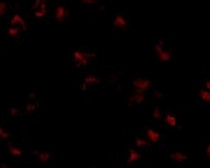
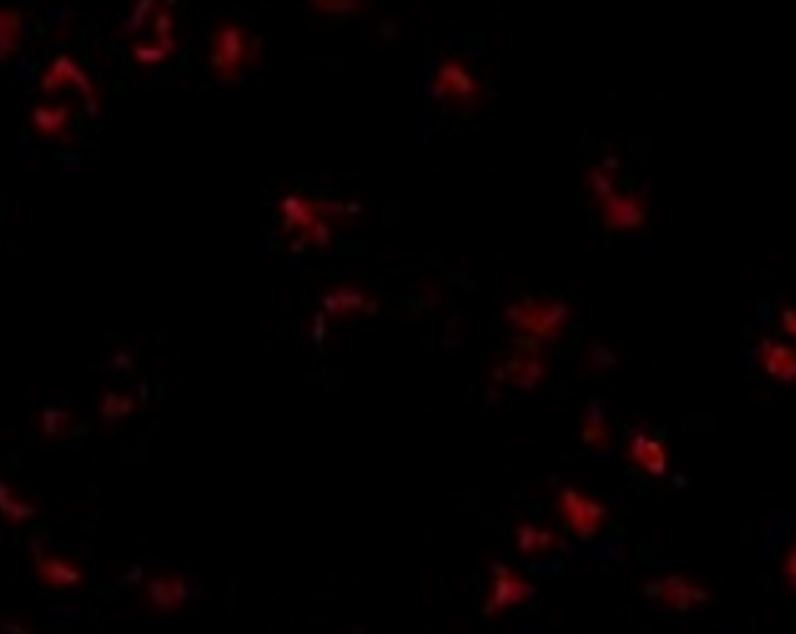
ARG46185 anti-GNPDA1 antibody ICC/IF image
Immunofluorescence: 293 stained with ARG46185 anti-GNPDA1 antibody.
-
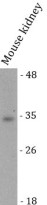
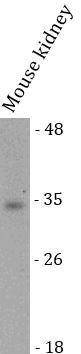
ARG46185 anti-GNPDA1 antibody WB image
Western blot: Mouse kidney stained with ARG46185 anti-GNPDA1 antibody.