ARG46715
anti-Histone H2A.X Acetyl (Lys5) antibody [RM445]
anti-Histone H2A.X Acetyl (Lys5) antibody [RM445] for Western blot and Human
Overview
| Product Description | Rabbit Monoclonal antibody [RM445] recognizes Histone H2A.X Acetyl (Lys5) |
|---|---|
| Tested Reactivity | Hu |
| Tested Application | WB |
| Host | Rabbit |
| Clonality | Monoclonal |
| Clone | RM445 |
| Isotype | IgG |
| Target Name | Histone H2A.X |
| Immunogen | A peptide corresponding to acetyl-Histone H2A.X (Lys5). |
| Conjugation | Un-conjugated |
| Alternate Names | H2AX; H2A.X Variant Histone; H2AFX; H2A Histone Family Member X; Histone H2A.X; Histone H2AX; H2A Histone Family, Member X; H2AX Histone; H2A.X; H2A/X; H2a/X |
Application Instructions
| Application Suggestion |
|
||||
|---|---|---|---|---|---|
| Application Note | * The dilutions indicate recommended starting dilutions and the optimal dilutions or concentrations should be determined by the scientist. |
Properties
| Form | Liquid |
|---|---|
| Purification | Protein A affinity purified. |
| Buffer | PBS with 50% Glycerol, 1% BSA and 0.09% sodium azide |
| Preservative | 0.09% sodium azide |
| Stabilizer | 50% Glycerol, 1% BSA and 0.09% |
| Concentration | 1 mg/ml |
| Storage Instruction | For continuous use, store undiluted antibody at 2-8°C for up to a week. For long-term storage, aliquot and store at -20°C or below. Storage in frost free freezers is not recommended. Avoid repeated freeze/thaw cycles. Suggest spin the vial prior to opening. The antibody solution should be gently mixed before use. |
| Note | For laboratory research only, not for drug, diagnostic or other use. |
Bioinformation
| Database Links | |
|---|---|
| Gene Symbol | H2AX |
| Gene Full Name | H2A.X Variant Histone |
| Background | Histones are basic nuclear proteins that are responsible for the nucleosome structure of the chromosomal fiber in eukaryotes. Two molecules of each of the four core histones (H2A, H2B, H3, and H4) form an octamer, around which approximately 146 bp of DNA is wrapped in repeating units, called nucleosomes. The linker histone, H1, interacts with linker DNA between nucleosomes and functions in the compaction of chromatin into higher order structures. This gene encodes a replication-independent histone that is a member of the histone H2A family, and generates two transcripts through the use of the conserved stem-loop termination motif, and the polyA addition motif. [provided by RefSeq, Oct 2015] |
| Function | Variant histone H2A which replaces conventional H2A in a subset of nucleosomes. Nucleosomes wrap and compact DNA into chromatin, limiting DNA accessibility to the cellular machineries which require DNA as a template. Histones thereby play a central role in transcription regulation, DNA repair, DNA replication and chromosomal stability. DNA accessibility is regulated via a complex set of post-translational modifications of histones, also called histone code, and nucleosome remodeling. Required for checkpoint-mediated arrest of cell cycle progression in response to low doses of ionizing radiation and for efficient repair of DNA double strand breaks (DSBs) specifically when modified by C-terminal phosphorylation. [UniProt] |
Images (1) Click the Picture to Zoom In
-
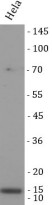
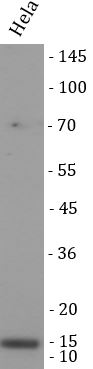
ARG46715 anti-Histone H2A.X Acetyl (Lys5) antibody [RM445] WB image
Western blot: Hela stained with ARG46715 anti-Histone H2A.X Acetyl (Lys5) antibody [RM445] at 0.04 µg/mL dilution.