ARG46713
anti-Histone H3 Phospho (Thr11) antibody [RM164]
anti-Histone H3 Phospho (Thr11) antibody [RM164] for Western blot and Human
Overview
| Product Description | Rabbit Monoclonal antibody [RM164] recognizes Histone H3 Phospho (Thr11) |
|---|---|
| Tested Reactivity | Hu |
| Tested Application | WB |
| Host | Rabbit |
| Clonality | Monoclonal |
| Clone | RM164 |
| Isotype | IgG |
| Target Name | Histone H3 |
| Immunogen | A phospho-peptide corresponding to Phospho-Histone H3 (Thr11). |
| Conjugation | Un-conjugated |
| Alternate Names | Histone H3/f; Histone H3.1; Histone H3/d; Histone H3/b; Histone H3/c; Histone H3/a; Histone H3/l; Histone H3/j; Histone H3/k; Histone H3/h; H3/A; H3FA; Histone H3/i |
Application Instructions
| Application Suggestion |
|
||||
|---|---|---|---|---|---|
| Application Note | * The dilutions indicate recommended starting dilutions and the optimal dilutions or concentrations should be determined by the scientist. |
Properties
| Form | Liquid |
|---|---|
| Purification | Protein A affinity purified. |
| Buffer | PBS with 50% Glycerol, 1% BSA and 0.09% sodium azide |
| Preservative | 0.09% sodium azide |
| Stabilizer | 50% Glycerol, 1% BSA and 0.09% |
| Concentration | 1 mg/ml |
| Storage Instruction | For continuous use, store undiluted antibody at 2-8°C for up to a week. For long-term storage, aliquot and store at -20°C or below. Storage in frost free freezers is not recommended. Avoid repeated freeze/thaw cycles. Suggest spin the vial prior to opening. The antibody solution should be gently mixed before use. |
| Note | For laboratory research only, not for drug, diagnostic or other use. |
Bioinformation
| Database Links | |
|---|---|
| Gene Symbol | HIST1H3A |
| Gene Full Name | histone cluster 1, H3a |
| Background | Histones are basic nuclear proteins that are responsible for the nucleosome structure of the chromosomal fiber in eukaryotes. This structure consists of approximately 146 bp of DNA wrapped around a nucleosome, an octamer composed of pairs of each of the four core histones (H2A, H2B, H3, and H4). The chromatin fiber is further compacted through the interaction of a linker histone, H1, with the DNA between the nucleosomes to form higher order chromatin structures. This gene is intronless and encodes a replication-dependent histone that is a member of the histone H3 family. Transcripts from this gene lack polyA tails; instead, they contain a palindromic termination element. This gene is found in the large histone gene cluster on chromosome 6p22-p21.3. [provided by RefSeq, Aug 2015] |
| Function | Core component of nucleosome. Nucleosomes wrap and compact DNA into chromatin, limiting DNA accessibility to the cellular machineries which require DNA as a template. Histones thereby play a central role in transcription regulation, DNA repair, DNA replication and chromosomal stability. DNA accessibility is regulated via a complex set of post-translational modifications of histones, also called histone code, and nucleosome remodeling. [UniProt] |
Images (1) Click the Picture to Zoom In
-
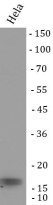
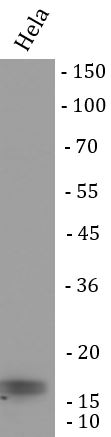
ARG46713 anti-Histone H3 Phospho (Thr11) antibody [RM164] WB image
Western blot: Hela stained with ARG46713 anti-Histone H3 Phospho (Thr11) antibody [RM164] at 0.5 µg/mL dilution.