ARG46825
anti-Homer 1 antibody
anti-Homer 1 antibody for Western blot,ICC/IF and Human,Mouse
Overview
| Product Description | Rabbit Polyclonal antibody recognizes Homer 1 |
|---|---|
| Tested Reactivity | Hu, Ms |
| Tested Application | ICC/IF, WB |
| Host | Rabbit |
| Clonality | Polyclonal |
| Isotype | IgG |
| Target Name | Homer 1 |
| Immunogen | Synthetic peptide. |
| Conjugation | Un-conjugated |
| Alternate Names | HOMER; SYN47; Ves-1; Homer-1; HOMER1A; Homer protein homolog 1; HOMER1C; HOMER1B |
Application Instructions
| Application Suggestion |
|
||||||
|---|---|---|---|---|---|---|---|
| Application Note | * The dilutions indicate recommended starting dilutions and the optimal dilutions or concentrations should be determined by the scientist. | ||||||
| Observed Size | 46 kDa |
Properties
| Form | Liquid |
|---|---|
| Purification | Affinity purification with immunogen |
| Purification Note | PBS, 50% Glycerol, Proclin 300 or sodium azide |
| Purity | Proclin 300 or sodium azide |
| Buffer | 50% Glycerol |
| Storage Instruction | For continuous use, store undiluted antibody at 2-8°C for up to a week. For long-term storage, aliquot and store at -20°C or below. Storage in frost free freezers is not recommended. Avoid repeated freeze/thaw cycles. Suggest spin the vial prior to opening. The antibody solution should be gently mixed before use. |
| Note | For laboratory research only, not for drug, diagnostic or other use. |
Bioinformation
| Database Links | |
|---|---|
| Gene Symbol | HOMER1 |
| Gene Full Name | homer scaffolding protein 1 |
| Background | This gene encodes a member of the homer family of dendritic proteins. Members of this family regulate group 1 metabotrophic glutamate receptor function. [provided by RefSeq, Jul 2008] |
| Function | Postsynaptic density scaffolding protein. Binds and cross-links cytoplasmic regions of GRM1, GRM5, ITPR1, DNM3, RYR1, RYR2, SHANK1 and SHANK3. By physically linking GRM1 and GRM5 with ER-associated ITPR1 receptors, it aids the coupling of surface receptors to intracellular calcium release. May also couple GRM1 to PI3 kinase through its interaction with AGAP2. Isoform 1 regulates the trafficking and surface expression of GRM5. Isoform 3 acts as a natural dominant negative, in dynamic competition with constitutively expressed isoform 1 to regulate synaptic metabotropic glutamate function. Isoform 3, may be involved in the structural changes that occur at synapses during long-lasting neuronal plasticity and development. [UniProt] |
| Calculated MW | 40 kDa |
Images (2) Click the Picture to Zoom In
-
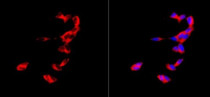
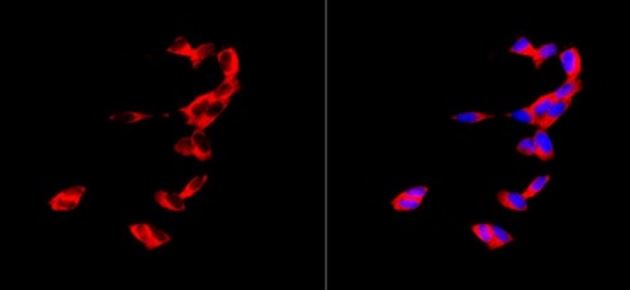
ARG46825 anti-Homer 1 antibody ICC/IF image
Immunofluorescence: SH-SY5Y stained with ARG46825 anti-Homer 1 antibody.
-
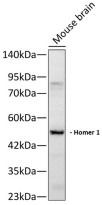
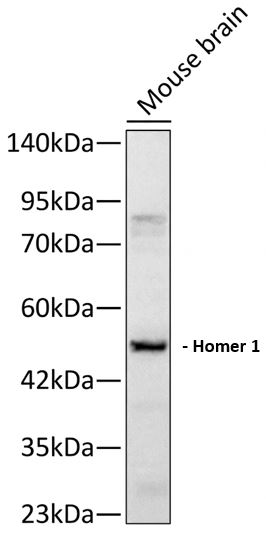
ARG46825 anti-Homer 1 antibody WB image
Western blot: Mouse brain stained with ARG46825 anti-Homer 1 antibody.