ARG22266
anti-Hsp 40 antibody [3B9.E6]
anti-Hsp 40 antibody [3B9.E6] for ELISA,ICC/IF,IHC-Formalin-fixed paraffin-embedded sections,Immunoprecipitation,Western blot and Human,Mouse,Rat
Overview
| Product Description | Mouse Monoclonal antibody [3B9.E6] recognizes Hsp 40 |
|---|---|
| Tested Reactivity | Hu, Ms, Rat |
| Tested Application | ELISA, ICC/IF, IHC-P, IP, WB |
| Specificity | Detects ~40kDa. Does not cross-react with HDJ2 or YDJ1. |
| Host | Mouse |
| Clonality | Monoclonal |
| Clone | 3B9.E6 |
| Isotype | IgG1 |
| Target Name | Hsp 40 |
| Antigen Species | Human |
| Immunogen | Recombinant Protein HSP40 |
| Conjugation | Un-conjugated |
| Alternate Names | Hsp40; HSP40; DnaJ protein homolog 1; hDj-1; HSPF1; Human DnaJ protein 1; Hdj1; RSPH16B; Heat shock 40 kDa protein 1; DnaJ homolog subfamily B member 1; Heat shock protein 40; Sis1 |
Application Instructions
| Application Suggestion |
|
||||||||||||
|---|---|---|---|---|---|---|---|---|---|---|---|---|---|
| Application Note | * The dilutions indicate recommended starting dilutions and the optimal dilutions or concentrations should be determined by the scientist. |
Properties
| Form | Liquid |
|---|---|
| Purification | Purification with Protein G. |
| Buffer | PBS (pH 7.2), 0.09% Sodium azide and 50% Glycerol |
| Preservative | 0.09% Sodium azide |
| Stabilizer | 50% Glycerol |
| Concentration | 1 mg/ml |
| Storage Instruction | For continuous use, store undiluted antibody at 2-8°C for up to a week. For long-term storage, aliquot and store at -20°C. Storage in frost free freezers is not recommended. Avoid repeated freeze/thaw cycles. Suggest spin the vial prior to opening. The antibody solution should be gently mixed before use. |
| Note | For laboratory research only, not for drug, diagnostic or other use. |
Bioinformation
| Database Links | |
|---|---|
| Gene Symbol | DNAJB1 |
| Gene Full Name | DnaJ (Hsp40) homolog, subfamily B, member 1 |
| Background | This gene encodes a member of the DnaJ or Hsp40 (heat shock protein 40 kD) family of proteins. DNAJ family members are characterized by a highly conserved amino acid stretch called the 'J-domain' and function as one of the two major classes of molecular chaperones involved in a wide range of cellular events, such as protein folding and oligomeric protein complex assembly. The encoded protein is a molecular chaperone that stimulates the ATPase activity of Hsp70 heat-shock proteins in order to promote protein folding and prevent misfolded protein aggregation. Alternative splicing results in multiple transcript variants. [provided by RefSeq, Sep 2015] |
| Function | Interacts with HSP70 and can stimulate its ATPase activity. Stimulates the association between HSC70 and HIP. [UniProt] |
| Cellular Localization | Cytoplasm, Nucleus |
| Calculated MW | 38 kDa |
Images (1) Click the Picture to Zoom In
-
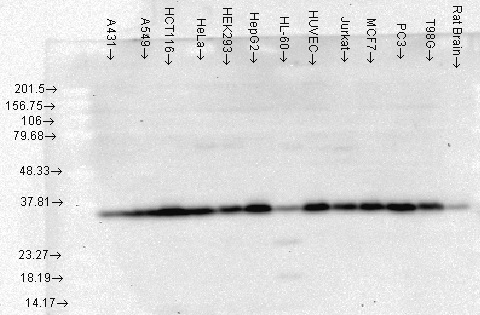
ARG22266 anti-Hsp 40 antibody [3B9.E6] WB image
Western blot: Human cell lysates and Rat brain lysate stained with ARG22266 anti-Hsp 40 antibody [3B9.E6] at 1:1000 dilution.