ARG63513
anti-IBP / DEF6 antibody
anti-IBP / DEF6 antibody for Western blot and Human
Signaling Transduction antibody
Overview
| Product Description | Goat Polyclonal antibody recognizes IBP / DEF6 |
|---|---|
| Tested Reactivity | Hu |
| Predict Reactivity | Ms, Rat, Cow, Dog, Pig |
| Tested Application | WB |
| Host | Goat |
| Clonality | Polyclonal |
| Isotype | IgG |
| Target Name | IBP / DEF6 |
| Antigen Species | Human |
| Immunogen | ALRKELLKSIWYA-C |
| Conjugation | Un-conjugated |
| Alternate Names | SLAT; Differentially expressed in FDCP 6 homolog; IBP; IRF4-binding protein; DEF-6; SWAP70L |
Application Instructions
| Application Suggestion |
|
||||
|---|---|---|---|---|---|
| Application Note | WB: Recommend incubate at RT for 1h. * The dilutions indicate recommended starting dilutions and the optimal dilutions or concentrations should be determined by the scientist. |
Properties
| Form | Liquid |
|---|---|
| Purification | Purified from goat serum by antigen affinity chromatography. |
| Buffer | Tris saline (pH 7.3), 0.02% Sodium azide and 0.5% BSA. |
| Preservative | 0.02% Sodium azide |
| Stabilizer | 0.5% BSA |
| Concentration | 0.5 mg/ml |
| Storage Instruction | For continuous use, store undiluted antibody at 2-8°C for up to a week. For long-term storage, aliquot and store at -20°C or below. Storage in frost free freezers is not recommended. Avoid repeated freeze/thaw cycles. Suggest spin the vial prior to opening. The antibody solution should be gently mixed before use. |
| Note | For laboratory research only, not for drug, diagnostic or other use. |
Bioinformation
| Database Links |
Swiss-port # Q9H4E7 Human Differentially expressed in FDCP 6 homolog |
|---|---|
| Background | DEF6, or IBP, is a guanine nucleotide exchange factor (GEF) for RAC (MIM 602048) and CDC42 (MIM 116952) that is highly expressed in B and T cells (Gupta et al., 2003 [PubMed 12923183]).[supplied by OMIM, Mar 2008] |
| Research Area | Signaling Transduction antibody |
| Calculated MW | 74 kDa |
| PTM | Tyrosine-phosphorylated by tyrosine-protein kinase LCK in response to T-cell activation. |
Images (1) Click the Picture to Zoom In
-
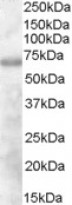
ARG63513 anti-IBP / DEF6 antibody WB image
Western Blot: Human Thymus lysate (35 µg protein in RIPA buffer) stained with ARG63513 anti-IBP / DEF6 antibody at 1 µg/ml dilution.