ARG42170
anti-IFI27 antibody
anti-IFI27 antibody for Western blot and Human
Overview
| Product Description | Rabbit Polyclonal antibody recognizes IFI27 |
|---|---|
| Tested Reactivity | Hu |
| Tested Application | WB |
| Host | Rabbit |
| Clonality | Polyclonal |
| Isotype | IgG |
| Target Name | IFI27 |
| Antigen Species | Human |
| Immunogen | KLH-conjugated synthetic peptide between aa. 72-106 of Human IFI27. |
| Conjugation | Un-conjugated |
| Alternate Names | a; Interferon alpha-inducible protein 27, mitochondrial; ISG12A; Interferon-stimulated gene 12a protein; p27; P27; ISG12; FAM14D; Interferon alpha-induced 11.5 kDa protein |
Application Instructions
| Application Suggestion |
|
||||
|---|---|---|---|---|---|
| Application Note | * The dilutions indicate recommended starting dilutions and the optimal dilutions or concentrations should be determined by the scientist. | ||||
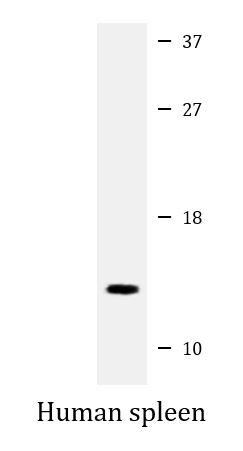
| Positive Control | Human spleen | ||||
| Observed Size | ~ 13 kDa |
Properties
| Form | Liquid |
|---|---|
| Purification | Purification with Protein A and immunogen peptide. |
| Buffer | PBS and 0.09% (W/V) Sodium azide. |
| Preservative | 0.09% (W/V) Sodium azide |
| Storage Instruction | For continuous use, store undiluted antibody at 2-8°C for up to a week. For long-term storage, aliquot and store at -20°C or below. Storage in frost free freezers is not recommended. Avoid repeated freeze/thaw cycles. Suggest spin the vial prior to opening. The antibody solution should be gently mixed before use. |
| Note | For laboratory research only, not for drug, diagnostic or other use. |
Bioinformation
| Database Links |
Swiss-port # P40305 Human Interferon alpha-inducible protein 27, mitochondrial |
|---|---|
| Gene Symbol | IFI27 |
| Gene Full Name | interferon, alpha-inducible protein 27 |
| Function | Probable adapter protein involved in different biological processes (PubMed:22427340, PubMed:27194766). Part of the signaling pathways that lead to apoptosis (PubMed:18330707, PubMed:27673746, PubMed:24970806). Involved in type-I interferon-induced apoptosis characterized by a rapid and robust release of cytochrome C from the mitochondria and activation of BAX and caspases 2, 3, 6, 8 and 9 (PubMed:18330707, PubMed:27673746). Also functions in TNFSF10-induced apoptosis (PubMed:24970806). May also have a function in the nucleus, where it may be involved in the interferon-induced negative regulation of the transcriptional activity of NR4A1, NR4A2 and NR4A3 through the enhancement of XPO1-mediated nuclear export of these nuclear receptors (PubMed:22427340). May thereby play a role in the vascular response to injury (By similarity). In the innate immune response, has an antiviral activity towards hepatitis C virus/HCV (PubMed:27194766, PubMed:27777077). May prevent the replication of the virus by recruiting both the hepatitis C virus non-structural protein 5A/NS5A and the ubiquitination machinery via SKP2, promoting the ubiquitin-mediated proteasomal degradation of NS5A (PubMed:27194766, PubMed:27777077). [UniProt] |
| Cellular Localization | Mitochondrion. Membrane; Multi-pass membrane protein. [UniProt] |
| Calculated MW | 12 kDa |
Images (1) Click the Picture to Zoom In
-
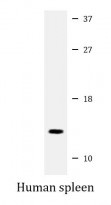
ARG42170 anti-IFI27 antibody WB image
Western blot: 20 µg of Human spleen lysate stained with ARG42170 anti-IFI27 antibody at 1:500 dilution.