ARG46232
anti-KANK1 antibody
anti-KANK1 antibody for Western blot,IHC-Formalin-fixed paraffin-embedded sections and Human,Mouse
Overview
| Product Description | Rabbit Polyclonal antibody recognizes KANK1 |
|---|---|
| Tested Reactivity | Hu, Ms |
| Tested Application | IHC-P, WB |
| Host | Rabbit |
| Clonality | Polyclonal |
| Isotype | IgG |
| Target Name | KANK1 |
| Antigen Species | Human |
| Immunogen | A 19 amino acid synthetic peptide within the first 50 amino acids of human KANK1. |
| Conjugation | Un-conjugated |
| Alternate Names | KN motif and ankyrin repeat domains 1; KANK1; KANK; CPSQ2; ANKRD15; KANK; KIAA0172; KN motif and ankyrin repeat domain-containing protein 1; Ankyrin repeat domain-containing protein 15 |
Application Instructions
| Application Suggestion |
|
||||||
|---|---|---|---|---|---|---|---|
| Application Note | * The dilutions indicate recommended starting dilutions and the optimal dilutions or concentrations should be determined by the scientist. | ||||||
| Observed Size | 150 kDa |
Properties
| Form | Liquid |
|---|---|
| Purification | Affinity chromatography purified |
| Buffer | PBS and 0.02% Sodium azide. |
| Preservative | 0.02% Sodium azide |
| Concentration | 1 mg/ml |
| Storage Instruction | For continuous use, store undiluted antibody at 2-8°C for up to a week. For long-term storage, aliquot and store at -282°C or below. Storage in frost free freezers is not recommended. Avoid repeated freeze/thaw cycles. Suggest spin the vial prior to opening. The antibody solution should be gently mixed before use. |
| Note | For laboratory research only, not for drug, diagnostic or other use. |
Bioinformation
| Database Links |
Swiss-port # Q14678 Human KN motif and ankyrin repeat domain-containing protein 1 |
|---|---|
| Gene Symbol | KANK1 |
| Gene Full Name | KN motif and ankyrin repeat domains 1 |
| Background | The protein encoded by this gene belongs to the Kank family of proteins, which contain multiple ankyrin repeat domains. This family member functions in cytoskeleton formation by regulating actin polymerization. This gene is a candidate tumor suppressor for renal cell carcinoma. Mutations in this gene cause cerebral palsy spastic quadriplegic type 2, a central nervous system development disorder. A t(5;9) translocation results in fusion of the platelet-derived growth factor receptor beta gene (PDGFRB) on chromosome 5 with this gene in a myeloproliferative neoplasm featuring severe thrombocythemia. Alternative splicing of this gene results in multiple transcript variants. A related pseudogene has been identified on chromosome 20. [provided by RefSeq, Dec 2014] |
| Function | Adapter protein that links structural and signaling protein complexes positioned to guide microtubule and actin cytoskeleton dynamics during cell morphogenesis. [UniProt] |
| Cellular Localization | Cytoplasm; Nucleus; Cell projection. [UniProt] |
| Calculated MW | 149 kDa |
| PTM | Phosphoprotein. [UniProt] |
Images (2) Click the Picture to Zoom In
-
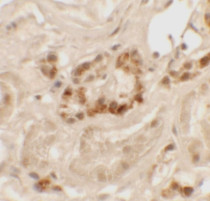
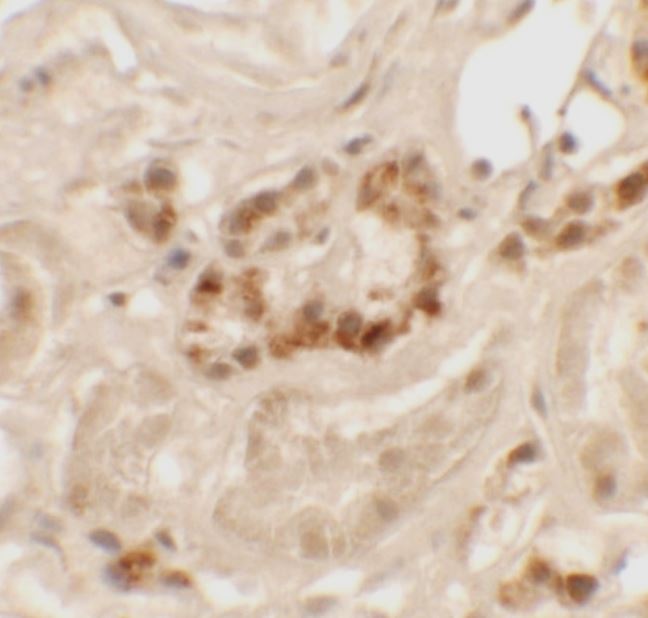
ARG46232 anti-KANK1 antibody IHC-P image
Immunohistochemistry: Human kidney stained with ARG46232 anti-KANK1 antibody.
-
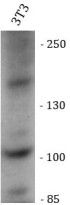
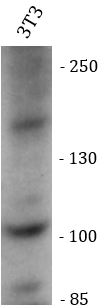
ARG46232 anti-KANK1 antibody WB image
Western blot: 3T3 stained with ARG46232 anti-KANK1 antibody.