ARG56987
anti-LITAF antibody [5C10]
anti-LITAF antibody [5C10] for Western blot and Human
Overview
| Product Description | Mouse Monoclonal antibody [5C10] recognizes LITAF |
|---|---|
| Tested Reactivity | Hu |
| Tested Application | WB |
| Host | Mouse |
| Clonality | Monoclonal |
| Clone | 5C10 |
| Isotype | IgG2b, kappa |
| Target Name | LITAF |
| Antigen Species | Human |
| Immunogen | Recombinant fragment around aa. 1-161 of Human LITAF. |
| Conjugation | Un-conjugated |
| Alternate Names | SIMPLE; TP53I7; Small integral membrane protein of lysosome/late endosome; Lipopolysaccharide-induced tumor necrosis factor-alpha factor; PIG7; LPS-induced TNF-alpha factor; p53-induced gene 7 protein |
Application Instructions
| Application Suggestion |
|
||||
|---|---|---|---|---|---|
| Application Note | * The dilutions indicate recommended starting dilutions and the optimal dilutions or concentrations should be determined by the scientist. |
Properties
| Form | Liquid |
|---|---|
| Purification | Purification with Protein G. |
| Buffer | PBS (pH 7.4), 0.02% Sodium azide and 10% Glycerol. |
| Preservative | 0.02% Sodium azide |
| Stabilizer | 10% Glycerol |
| Concentration | 1 mg/ml |
| Storage Instruction | For continuous use, store undiluted antibody at 2-8°C for up to a week. For long-term storage, aliquot and store at -20°C. Storage in frost free freezers is not recommended. Avoid repeated freeze/thaw cycles. Suggest spin the vial prior to opening. The antibody solution should be gently mixed before use. |
| Note | For laboratory research only, not for drug, diagnostic or other use. |
Bioinformation
| Database Links |
Swiss-port # Q99732 Human Lipopolysaccharide-induced tumor necrosis factor-alpha factor |
|---|---|
| Gene Symbol | LITAF |
| Gene Full Name | lipopolysaccharide-induced TNF factor |
| Background | Lipopolysaccharide is a potent stimulator of monocytes and macrophages, causing secretion of tumor necrosis factor-alpha (TNF-alpha) and other inflammatory mediators. This gene encodes lipopolysaccharide-induced TNF-alpha factor, which is a DNA-binding protein and can mediate the TNF-alpha expression by direct binding to the promoter region of the TNF-alpha gene. The transcription of this gene is induced by tumor suppressor p53 and has been implicated in the p53-induced apoptotic pathway. Mutations in this gene cause Charcot-Marie-Tooth disease type 1C (CMT1C) and may be involved in the carcinogenesis of extramammary Paget's disease (EMPD). Multiple alternatively spliced transcript variants have been found for this gene. [provided by RefSeq, Dec 2014] |
| Function | Probable role in regulating transcription of specific genes. May regulate through NFKB1 the expression of the CCL2/MCP-1 chemokine. May play a role in tumor necrosis factor alpha (TNF-alpha) gene expression. [UniProt] |
| Calculated MW | 17 kDa |
| PTM | Phosphorylated on tyrosine residues in response to EGF. |
Images (1) Click the Picture to Zoom In
-
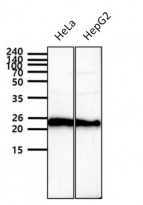
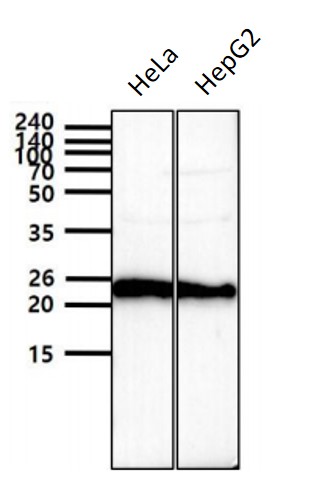
ARG56987 anti-LITAF antibody [5C10] WB image
Western blot: 40 µg of HeLa and HepG2 cell lysates stained with ARG56987 anti-LITAF antibody [5C10] at 1:1000 dilution.