ARG63262
anti-NFATC4 antibody
anti-NFATC4 antibody for IHC-Formalin-fixed paraffin-embedded sections and Human
Gene Regulation antibody; Immune System antibody; Signaling Transduction antibody
Overview
| Product Description | Goat Polyclonal antibody recognizes NFATC4 |
|---|---|
| Tested Reactivity | Hu |
| Predict Reactivity | Ms, Rat, Dog, Pig |
| Tested Application | IHC-P |
| Specificity | This antibody is expected to recognise isoform 2, 3, 4 and 5 (NP_004545.2; NP_001185894.1; NP_001185895.1; NP_001185896.1 respectively). |
| Host | Goat |
| Clonality | Polyclonal |
| Isotype | IgG |
| Target Name | NFATC4 |
| Antigen Species | Human |
| Immunogen | C-SGFPAPPGEEPPA |
| Conjugation | Un-conjugated |
| Alternate Names | NFATc4; NFAT3; T-cell transcription factor NFAT3; Nuclear factor of activated T-cells, cytoplasmic 4; NF-ATc4; NF-ATC4; NF-AT3 |
Application Instructions
| Application Suggestion |
|
||||
|---|---|---|---|---|---|
| Application Note | IHC-P: Antigen Retrieval: Steam tissue section in Citrate buffer (pH 6.0). * The dilutions indicate recommended starting dilutions and the optimal dilutions or concentrations should be determined by the scientist. |
Properties
| Form | Liquid |
|---|---|
| Purification | Purified from goat serum by antigen affinity chromatography. |
| Buffer | Tris saline (pH 7.3), 0.02% Sodium azide and 0.5% BSA. |
| Preservative | 0.02% Sodium azide |
| Stabilizer | 0.5% BSA |
| Concentration | 0.5 mg/ml |
| Storage Instruction | For continuous use, store undiluted antibody at 2-8°C for up to a week. For long-term storage, aliquot and store at -20°C or below. Storage in frost free freezers is not recommended. Avoid repeated freeze/thaw cycles. Suggest spin the vial prior to opening. The antibody solution should be gently mixed before use. |
| Note | For laboratory research only, not for drug, diagnostic or other use. |
Bioinformation
| Database Links |
Swiss-port # Q14934 Human Nuclear factor of activated T-cells, cytoplasmic 4 |
|---|---|
| Background | The product of this gene is a member of the nuclear factors of activated T cells DNA-binding transcription complex. This complex consists of at least two components: a preexisting cytosolic component that translocates to the nucleus upon T cell receptor (TCR) stimulation and an inducible nuclear component. Other members of this family of nuclear factors of activated T cells also participate in the formation of this complex. The product of this gene plays a role in the inducible expression of cytokine genes in T cells, especially in the induction of the IL-2 and IL-4. Alternatively spliced transcript variants encoding different isoforms have been noted for this gene. [provided by RefSeq, Oct 2008] |
| Research Area | Gene Regulation antibody; Immune System antibody; Signaling Transduction antibody |
| Calculated MW | 95 kDa |
| PTM | Phosphorylated by NFATC-kinases; dephosphorylated by calcineurin. Phosphorylated on Ser-168 and Ser-170 by MTOR, IRAK1, MAPK7 and MAPK14, on Ser-213 and Ser-217 by MAPK8 and MAPK9, and on Ser-289 and Ser-344 by RPS6KA3. Phosphorylated by GSK3B. Ubiquitinated, leading to its degradation by the proteasome and reduced transcriptional activity. Ubiquitination and reduction in transcriptional activity can be further facilitated through GSK3B-dependent phosphorylation. Polyubiquitin linkage is mainly through 'Lys-48'. |
Images (1) Click the Picture to Zoom In
-
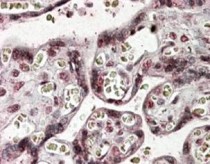
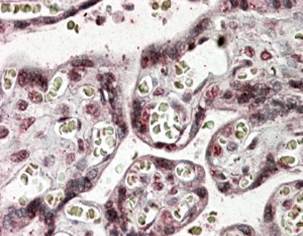
ARG63262 anti-NFATC4 antibody IHC-P image
Immunohistochemistry: paraffin embedded Human Placenta. (Steamed antigen retrieval with citrate buffer pH 6) stained with ARG63262 anti-NFATC4 antibody at 3.8 µg/ml dilution followed by AP-staining.