ARG67307
anti-PGC1 alpha antibody [6G01]
anti-PGC1 alpha antibody [6G01] for Western blot and Human
Overview
| Product Description | Mouse Monoclonal antibody [6G01] recognizes PGC1 alpha |
|---|---|
| Tested Reactivity | Hu |
| Tested Application | WB |
| Host | Mouse |
| Clonality | Monoclonal |
| Clone | 6G01 |
| Target Name | PGC1 alpha |
| Antigen Species | Human |
| Immunogen | Recombinant protein of Human PGC1 alpha. |
| Conjugation | Un-conjugated |
| Alternate Names | Ligand effect modulator 6; PGC1; PPARGC-1-alpha; PPARGC1; PGC1A; PPAR-gamma coactivator 1-alpha; PGC-1v; LEM6; PGC-1-alpha; Peroxisome proliferator-activated receptor gamma coactivator 1-alpha; PGC-1(alpha) |
Application Instructions
| Application Suggestion |
|
||||
|---|---|---|---|---|---|
| Application Note | * The dilutions indicate recommended starting dilutions and the optimal dilutions or concentrations should be determined by the scientist. |
Properties
| Form | Liquid |
|---|---|
| Purification | Affinity purification with immunogen. |
| Buffer | PBS, 50% glycerol, 0.02% sodium azide, 0.5%BSA |
| Preservative | 0.02% sodium azide |
| Stabilizer | 50% glycerol and 0.5% BSA |
| Storage Instruction | For continuous use, store undiluted antibody at 2-8°C for up to a week. For long-term storage, aliquot and store at -20°C or below. Storage in frost free freezers is not recommended. Avoid repeated freeze/thaw cycles. Suggest spin the vial prior to opening. The antibody solution should be gently mixed before use. |
| Note | For laboratory research only, not for drug, diagnostic or other use. |
Bioinformation
| Database Links |
Swiss-port # Q9UBK2 Human Peroxisome proliferator-activated receptor gamma coactivator 1-alpha |
|---|---|
| Gene Symbol | PPARGC1A |
| Gene Full Name | peroxisome proliferator-activated receptor gamma, coactivator 1 alpha |
| Background | The protein encoded by this gene is a transcriptional coactivator that regulates the genes involved in energy metabolism. This protein interacts with PPARgamma, which permits the interaction of this protein with multiple transcription factors. This protein can interact with, and regulate the activities of, cAMP response element binding protein (CREB) and nuclear respiratory factors (NRFs). It provides a direct link between external physiological stimuli and the regulation of mitochondrial biogenesis, and is a major factor that regulates muscle fiber type determination. This protein may be also involved in controlling blood pressure, regulating cellular cholesterol homoeostasis, and the development of obesity. [provided by RefSeq, Jul 2008] |
| Function | Transcriptional coactivator for steroid receptors and nuclear receptors. Greatly increases the transcriptional activity of PPARG and thyroid hormone receptor on the uncoupling protein promoter. Can regulate key mitochondrial genes that contribute to the program of adaptive thermogenesis. Plays an essential role in metabolic reprogramming in response to dietary availability through coordination of the expression of a wide array of genes involved in glucose and fatty acid metabolism. Induces the expression of PERM1 in the skeletal muscle in an ESRRA-dependent manner. Also involved in the integration of the circadian rhythms and energy metabolism. Required for oscillatory expression of clock genes, such as ARNTL/BMAL1 and NR1D1, through the coactivation of RORA and RORC, and metabolic genes, such as PDK4 and PEPCK. [UniProt] |
| Cellular Localization | Nucleus, Nucleus, PML body, Cytoplasm. [UniProt] |
| Calculated MW | 91 kDa |
| PTM | Phosphorylation by AMPK in skeletal muscle increases activation of its own promoter. Phosphorylated by CLK2. Heavily acetylated by GCN5 and biologically inactive under conditions of high nutrients. Deacetylated by SIRT1 in low nutrients/high NAD conditions. Ubiquitinated. Ubiquitination by RNF34 induces proteasomal degradation. [UniProt] |
Images (1) Click the Picture to Zoom In
-
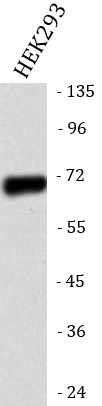
ARG67307 anti-PGC1 alpha antibody [6G01] WB image
Western blot: HEK293 stained with ARG67307 anti-PGC1 alpha antibody [6G01].