ARG55596
anti-PIK3C2B phospho (Tyr228) antibody
anti-PIK3C2B phospho (Tyr228) antibody for Western blot and Human
Immune System antibody; Signaling Transduction antibody
Overview
| Product Description | Rabbit Polyclonal antibody recognizes PIK3C2B phospho (Tyr228) |
|---|---|
| Tested Reactivity | Hu |
| Tested Application | WB |
| Host | Rabbit |
| Clonality | Polyclonal |
| Isotype | IgG |
| Target Name | PIK3C2B |
| Antigen Species | Human |
| Immunogen | KLH-conjugated phosphospecific peptide corresponding to aa. 215-250 of Human PIK3C2B. (Phosphorylated at Tyr228) |
| Conjugation | Un-conjugated |
| Alternate Names | EC 2.7.1.154; PtdIns-3-kinase C2 subunit beta; PI3K-C2-beta; C2-PI3K; Phosphatidylinositol 4-phosphate 3-kinase C2 domain-containing subunit beta; Phosphoinositide 3-kinase-C2-beta |
Application Instructions
| Application Suggestion |
|
||||
|---|---|---|---|---|---|
| Application Note | * The dilutions indicate recommended starting dilutions and the optimal dilutions or concentrations should be determined by the scientist. | ||||
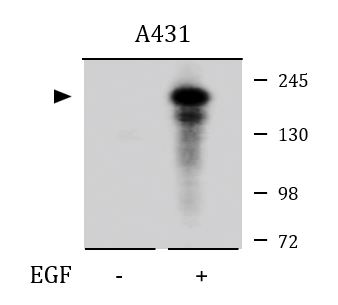
| Positive Control | A431 + EGF |
Properties
| Form | Liquid |
|---|---|
| Purification | Purification with Protein A and immunogen peptide. |
| Buffer | PBS and 0.09% (W/V) Sodium azide |
| Preservative | 0.09% (W/V) Sodium azide |
| Storage Instruction | For continuous use, store undiluted antibody at 2-8°C for up to a week. For long-term storage, aliquot and store at -20°C or below. Storage in frost free freezers is not recommended. Avoid repeated freeze/thaw cycles. Suggest spin the vial prior to opening. The antibody solution should be gently mixed before use. |
| Note | For laboratory research only, not for drug, diagnostic or other use. |
Bioinformation
| Database Links |
Swiss-port # O00750 Human Phosphatidylinositol 4-phosphate 3-kinase C2 domain-containing subunit bet |
|---|---|
| Gene Symbol | PIK3C2B |
| Gene Full Name | phosphatidylinositol-4-phosphate 3-kinase, catalytic subunit type 2 beta |
| Background | The protein encoded by this gene belongs to the phosphoinositide 3-kinase (PI3K) family. PI3-kinases play roles in signaling pathways involved in cell proliferation, oncogenic transformation, cell survival, cell migration, and intracellular protein trafficking. This protein contains a lipid kinase catalytic domain as well as a C-terminal C2 domain, a characteristic of class II PI3-kinases. C2 domains act as calcium-dependent phospholipid binding motifs that mediate translocation of proteins to membranes, and may also mediate protein-protein interactions. The PI3-kinase activity of this protein is sensitive to low nanomolar levels of the inhibitor wortmanin. The C2 domain of this protein was shown to bind phospholipids but not Ca2+, which suggests that this enzyme may function in a calcium-independent manner. [provided by RefSeq, Jul 2008] |
| Function | Phosphorylates PtdIns and PtdIns4P with a preference for PtdIns. Does not phosphorylate PtdIns(4,5)P2. May be involved in EGF and PDGF signaling cascades. [UniProt] |
| Cellular Localization | Microsome. Cell membrane. Cytoplasm, cytosol. Nucleus. Endoplasmic reticulum. Note=Found mostly in the microsome, but also in the plasma membrane and cytosol. Nuclear in testis |
| Research Area | Immune System antibody; Signaling Transduction antibody |
| Calculated MW | 185 kDa |
Images (1) Click the Picture to Zoom In
-
ARG55596 anti-PIK3C2B phospho (Tyr228) antibody WB image
Western blot: 35 µg of A431 cells untreated or treated with EGF. The blots were stained with ARG55596 anti-PIK3C2B phospho (Tyr228) antibody at 1:1000 dilution.