ARG46392
anti-POU3F2 / BRN2 / OCT7 antibody
anti-POU3F2 / BRN2 / OCT7 antibody for Western blot and Human,Mouse,Rat
Overview
| Product Description | Rabbit Polyclonal antibody recognizes POU3F2 / BRN2 / OCT7 |
|---|---|
| Tested Reactivity | Hu, Ms, Rat |
| Tested Application | WB |
| Host | Rabbit |
| Clonality | Polyclonal |
| Isotype | IgG |
| Target Name | POU3F2 / BRN2 / OCT7 |
| Antigen Species | Human |
| Immunogen | A 18 amino acid synthetic peptide within the last 50 amino acids of human POU3F2 / BRN2 / OCT7. |
| Conjugation | Un-conjugated |
| Alternate Names | POU3F2; BRN2; Octamer-binding transcription factor 7; Oct-7; Brain-2; brn-2; OCT7; Brn-2; N-Oct3; POUF3; Brain-specific homeobox/POU domain protein 2; Nervous system-specific octamer-binding transcription factor N-Oct-3; OTF7; oct-7; POU domain, class 3, transcription factor 2; OTF-7; Octamer-binding protein 7 |
Application Instructions
| Application Suggestion |
|
||||
|---|---|---|---|---|---|
| Application Note | * The dilutions indicate recommended starting dilutions and the optimal dilutions or concentrations should be determined by the scientist. |
Properties
| Purification | Affinity chromatography purified |
|---|---|
| Buffer | PBS and 0.02% Sodium azide. |
| Preservative | 0.02% Sodium azide |
| Concentration | 1 mg/ml |
| Storage Instruction | For continuous use, store undiluted antibody at 2-8°C for up to a week. For long-term storage, aliquot and store at -20°C. Storage in frost free freezers is not recommended. Avoid repeated freeze/thaw cycles. Suggest spin the vial prior to opening. The antibody solution should be gently mixed before use. |
| Note | For laboratory research only, not for drug, diagnostic or other use. |
Bioinformation
| Database Links | |
|---|---|
| Gene Symbol | POU3F2 |
| Gene Full Name | POU class 3 homeobox 2 |
| Background | This gene encodes a member of the POU-III class of neural transcription factors. The encoded protein is involved in neuronal differentiation and enhances the activation of corticotropin-releasing hormone regulated genes. Overexpression of this protein is associated with an increase in the proliferation of melanoma cells. [provided by RefSeq, Mar 2012] |
| Calculated MW | 47 kDa |
Images (1) Click the Picture to Zoom In
-
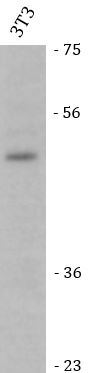
ARG46392 anti-POU3F2 / BRN2 / OCT7 antibody WB image
Western blot: 3T3 stained with ARG46392 anti-POU3F2 / BRN2 / OCT7 antibody.