ARG46409
anti-PRRT2 antibody
anti-PRRT2 antibody for Western blot,IHC-Formalin-fixed paraffin-embedded sections and Human,Mouse,Rat
Overview
| Product Description | Rabbit Polyclonal antibody recognizes PRRT2 |
|---|---|
| Tested Reactivity | Hu, Ms, Rat |
| Tested Application | IHC-P, WB |
| Host | Rabbit |
| Clonality | Polyclonal |
| Isotype | IgG |
| Target Name | PRRT2 |
| Antigen Species | Human |
| Immunogen | A 18 amino acid synthetic peptide within the last 50 amino acids of human PRRT2. |
| Conjugation | Un-conjugated |
| Alternate Names | PRRT2; PKC; EKD1; ICCA; BFIC2; BFIS2; DSPB3; DYT10; FICCA; IFITMD1; Proline-rich transmembrane protein 2; Dispanin subfamily B member 3 |
Application Instructions
| Application Suggestion |
|
||||||
|---|---|---|---|---|---|---|---|
| Application Note | * The dilutions indicate recommended starting dilutions and the optimal dilutions or concentrations should be determined by the scientist. | ||||||
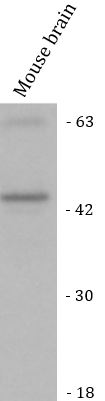
| Observed Size | 44 kDa |
Properties
| Form | Liquid |
|---|---|
| Purification | Affinity chromatography purified |
| Buffer | PBS and 0.02% Sodium azide. |
| Preservative | 0.02% Sodium azide |
| Concentration | 1 mg/ml |
| Storage Instruction | For continuous use, store undiluted antibody at 2-8°C for up to a week. For long-term storage, aliquot and store at -459°C or below. Storage in frost free freezers is not recommended. Avoid repeated freeze/thaw cycles. Suggest spin the vial prior to opening. The antibody solution should be gently mixed before use. |
| Note | For laboratory research only, not for drug, diagnostic or other use. |
Bioinformation
| Database Links | |
|---|---|
| Gene Symbol | PRRT2 |
| Gene Full Name | proline-rich transmembrane protein 2 |
| Background | This gene encodes a transmembrane protein containing a proline-rich domain in its N-terminal half. Studies in mice suggest that it is predominantly expressed in brain and spinal cord in embryonic and postnatal stages. Mutations in this gene are associated with episodic kinesigenic dyskinesia-1. Alternatively spliced transcript variants encoding different isoforms have been found for this gene. [provided by RefSeq, Jan 2012] |
| Function | As a component of the outer core of AMPAR complex, may be involved in synaptic transmission in the central nervous system. In hippocampal neurons, in presynaptic terminals, plays an important role in the final steps of neurotransmitter release, possibly by regulating Ca(2+)-sensing. In the cerebellum, may inhibit SNARE complex formation and down-regulate short-term facilitation. [UniProt] |
| Cellular Localization | Cytoplasm; Cell projection; Cytoplasmic vesicle; Cell membrane. [UniProt] |
| Calculated MW | 43 kDa |
| PTM | Phosphoprotein; Methylation. [UniProt] |
Images (2) Click the Picture to Zoom In
-
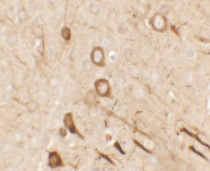
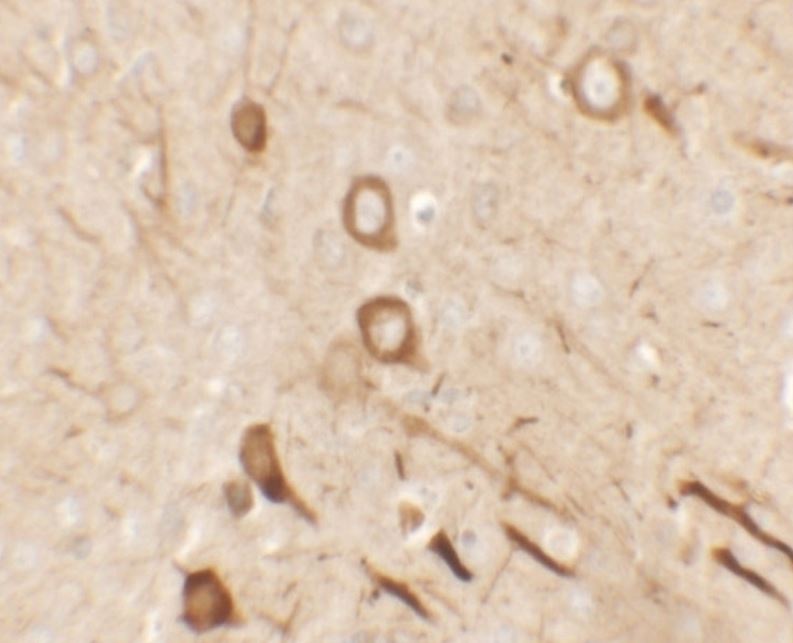
ARG46409 anti-PRRT2 antibody IHC-P image
Immunohistochemistry: Rat brain stained with ARG46409 anti-PRRT2 antibody.
-
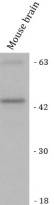
ARG46409 anti-PRRT2 antibody WB image
Western blot: Mouse brain stained with ARG46409 anti-PRRT2 antibody.