ARG46414
anti-PTPRD antibody
anti-PTPRD antibody for Western blot and Human
Overview
| Product Description | Rabbit Polyclonal antibody recognizes PTPRD |
|---|---|
| Tested Reactivity | Hu |
| Tested Application | WB |
| Host | Rabbit |
| Clonality | Polyclonal |
| Isotype | IgG |
| Target Name | PTPRD |
| Antigen Species | Human |
| Immunogen | A 18 amino acid synthetic peptide within the last 50 amino acids of human PTPRD. |
| Conjugation | Un-conjugated |
| Alternate Names | protein tyrosine phosphatase, receptor type, D; PTPRD; HPTP; PTPD; HPTPD; HPTPDELTA; RPTPDELTA; Receptor-type tyrosine-protein phosphatase delta; Protein-tyrosine phosphatase delta |
Application Instructions
| Application Suggestion |
|
||||
|---|---|---|---|---|---|
| Application Note | * The dilutions indicate recommended starting dilutions and the optimal dilutions or concentrations should be determined by the scientist. | ||||
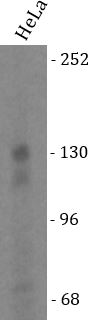
| Observed Size | 130 kDa |
Properties
| Form | Liquid |
|---|---|
| Purification | Affinity chromatography purified |
| Buffer | PBS and 0.02% Sodium azide. |
| Preservative | 0.02% Sodium azide |
| Concentration | 1 mg/ml |
| Storage Instruction | For continuous use, store undiluted antibody at 2-8°C for up to a week. For long-term storage, aliquot and store at -464°C or below. Storage in frost free freezers is not recommended. Avoid repeated freeze/thaw cycles. Suggest spin the vial prior to opening. The antibody solution should be gently mixed before use. |
| Note | For laboratory research only, not for drug, diagnostic or other use. |
Bioinformation
| Database Links |
Swiss-port # P23468 Human Receptor-type tyrosine-protein phosphatase delta |
|---|---|
| Gene Symbol | PTPRD |
| Gene Full Name | protein tyrosine phosphatase, receptor type, D |
| Background | The protein encoded by this gene is a member of the protein tyrosine phosphatase (PTP) family. PTPs are known to be signaling molecules that regulate a variety of cellular processes including cell growth, differentiation, mitotic cycle, and oncogenic transformation. This PTP contains an extracellular region, a single transmembrane segment and two tandem intracytoplasmic catalytic domains, and thus represents a receptor-type PTP. The extracellular region of this protein is composed of three Ig-like and eight fibronectin type III-like domains. Studies of the similar genes in chicken and fly suggest the role of this PTP is in promoting neurite growth, and regulating neurons axon guidance. Multiple alternatively spliced transcript variants of this gene have been reported. A related pseudogene has been identified on chromosome 5. [provided by RefSeq, Jan 2010] |
| Function | Can bidirectionally induce pre- and post-synaptic differentiation of neurons by mediating interaction with IL1RAP and IL1RAPL1 trans-synaptically. Involved in pre-synaptic differentiation through interaction with SLITRK2. [UniProt] |
| Calculated MW | 165, 210, 130 kDa |
| PTM | Disulfide bond; Glycoprotein. [UniProt] |
Images (1) Click the Picture to Zoom In
-
ARG46414 anti-PTPRD antibody WB image
Western blot: HeLa stained with ARG46414 anti-PTPRD antibody.