ARG46362
anti-Periphilin 1 antibody
anti-Periphilin 1 antibody for Western blot,IHC-Formalin-fixed paraffin-embedded sections and Human,Mouse
Overview
| Product Description | Rabbit Polyclonal antibody recognizes Periphilin 1 |
|---|---|
| Tested Reactivity | Hu, Ms |
| Tested Application | IHC-P, WB |
| Host | Rabbit |
| Clonality | Polyclonal |
| Isotype | IgG |
| Target Name | Periphilin 1 |
| Antigen Species | Human |
| Immunogen | A 16 amino acid synthetic peptide within the last 50 amino acids of human Periphilin 1. |
| Conjugation | Un-conjugated |
| Alternate Names | PPHLN1; periphilin 1; Periphilin; HSPC206; HSPC232; Periphilin-1; Gastric cancer antigen Ga50 |
Application Instructions
| Application Suggestion |
|
||||||
|---|---|---|---|---|---|---|---|
| Application Note | * The dilutions indicate recommended starting dilutions and the optimal dilutions or concentrations should be determined by the scientist. |
Properties
| Form | Liquid |
|---|---|
| Purification | Affinity chromatography purified |
| Buffer | PBS and 0.02% Sodium azide. |
| Preservative | 0.02% Sodium azide |
| Concentration | 1 mg/ml |
| Storage Instruction | For continuous use, store undiluted antibody at 2-8°C for up to a week. For long-term storage, aliquot and store at -412°C or below. Storage in frost free freezers is not recommended. Avoid repeated freeze/thaw cycles. Suggest spin the vial prior to opening. The antibody solution should be gently mixed before use. |
| Note | For laboratory research only, not for drug, diagnostic or other use. |
Bioinformation
| Database Links | |
|---|---|
| Gene Symbol | PPHLN1 |
| Gene Full Name | periphilin 1 |
| Background | The protein encoded by this gene is one of the several proteins that become sequentially incorporated into the cornified cell envelope during the terminal differentiation of keratinocyte at the outer layers of epidermis. This protein interacts with periplakin, which is known as a precursor of the cornified cell envelope. The cellular localization pattern and insolubility of this protein suggest that it may play a role in epithelial differentiation and contribute to epidermal integrity and barrier formation. Multiple alternatively spliced transcript variants encoding distinct isoforms have been observed. [provided by RefSeq, Jul 2008] |
| Function | Component of the HUSH complex, a multiprotein complex that mediates epigenetic repression. The HUSH complex is recruited to genomic loci rich in H3K9me3 and is probably required to maintain transcriptional silencing by promoting recruitment of SETDB1, a histone methyltransferase that mediates further deposition of H3K9me3. In the HUSH complex, contributes to the maintenance of the complex at chromatin. [UniProt] |
| Cellular Localization | Cytoplasm; Nucleus; Chromosome. [UniProt] |
| Calculated MW | 53 kDa |
| PTM | Phosphoprotein; Isopeptide bond; Ubl conjugation; Acetylation. [UniProt] |
Images (2) Click the Picture to Zoom In
-
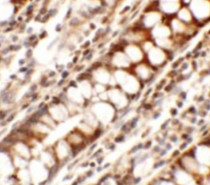
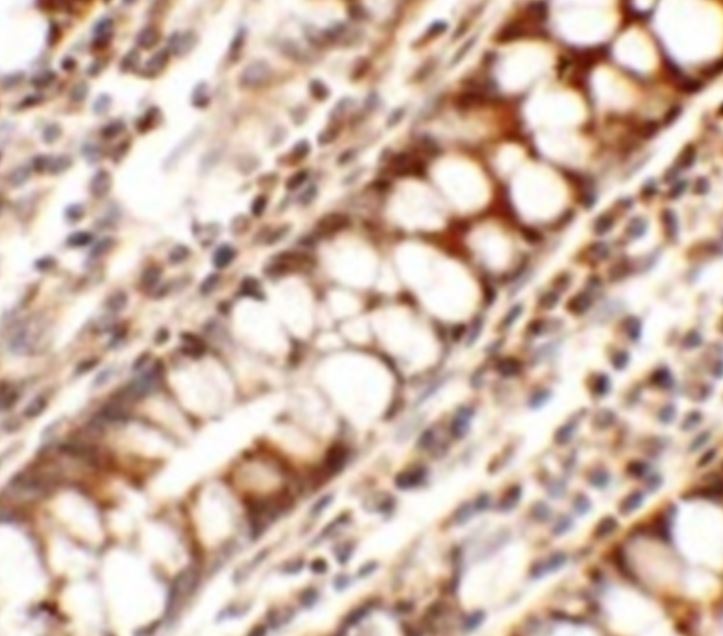
ARG46362 anti-Periphilin 1 antibody IHC-P image
Immunohistochemistry: Human colon stained with ARG46362 anti-Periphilin 1 antibody.
-
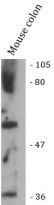
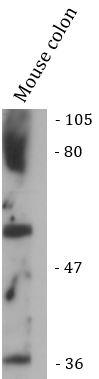
ARG46362 anti-Periphilin 1 antibody WB image
Western blot: Mouse colon stained with ARG46362 anti-Periphilin 1 antibody.