ARG23898
anti-Phosphoserine / threonine antibody
anti-Phosphoserine / threonine antibody for ELISA,ICC/IF,Immunoprecipitation,Western blot and Other
Overview
| Product Description | Rabbit Polyclonal antibody recognizes Phosphoserine / threonine |
|---|---|
| Tested Reactivity | Other |
| Tested Application | ELISA, ICC/IF, IP, WB |
| Specificity | This antibody detects many serine or threonine phosphorylated proteins by WB, ICC and ELISA. |
| Host | Rabbit |
| Clonality | Polyclonal |
| Isotype | IgG |
| Target Name | Serine / Threonine |
| Antigen Species | Human |
| Immunogen | A panel of phosphoserine and phosphothreonine-containing peptide immunogens designed from human protein sequences. All peptide sequences used are highly conserved in many species. |
| Conjugation | Un-conjugated |
Application Instructions
| Application Suggestion |
|
||||||||||
|---|---|---|---|---|---|---|---|---|---|---|---|
| Application Note | WB: Antibody is suggested to be diluted in 5% skimmed milk/Tris buffer with 0.04% Tween20 and incubated for 1 hour at room temperature. * The dilutions indicate recommended starting dilutions and the optimal dilutions or concentrations should be determined by the scientist. |
Properties
| Purification | Affinity purification with phospho-specific peptide and the non-phospho specific antibodies were removed by chromatography using non-phosphopeptide. |
|---|---|
| Buffer | PBS, 0.05% Sodium azide, 50% Glycerol and 1 mg/ml BSA. |
| Preservative | 0.05% Sodium azide |
| Stabilizer | 50% Glycerol and 1 mg/ml BSA |
| Storage Instruction | For continuous use, store undiluted antibody at 2-8°C for up to a week. For long-term storage, aliquot and store at -20°C. Storage in frost free freezers is not recommended. Avoid repeated freeze/thaw cycles. Suggest spin the vial prior to opening. The antibody solution should be gently mixed before use. |
| Note | For laboratory research only, not for drug, diagnostic or other use. |
Bioinformation
| Background | Phosphorylation of specific serine or threonine residues is an important post-translational modification for regulating the activity of most proteins. Stimulation of a variety of cell signaling pathways activates the receptor and non-receptor ser/thr kinases that mediate these protein modifications. Antibodies that can detect phosphoserine or phosphothreonine residues are excellent tools for characterizing changes in the post-translational state of a broad range of phosphorylated proteins. Immunoprecipitation of proteins of interest followed by detection of phosphoserine or phosphothreonine using anti-phosphoserine antibody is commonly used to correlate changes in phosphorylation state with alterations in protein activity. |
|---|
Images (3) Click the Picture to Zoom In
-
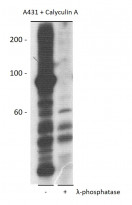
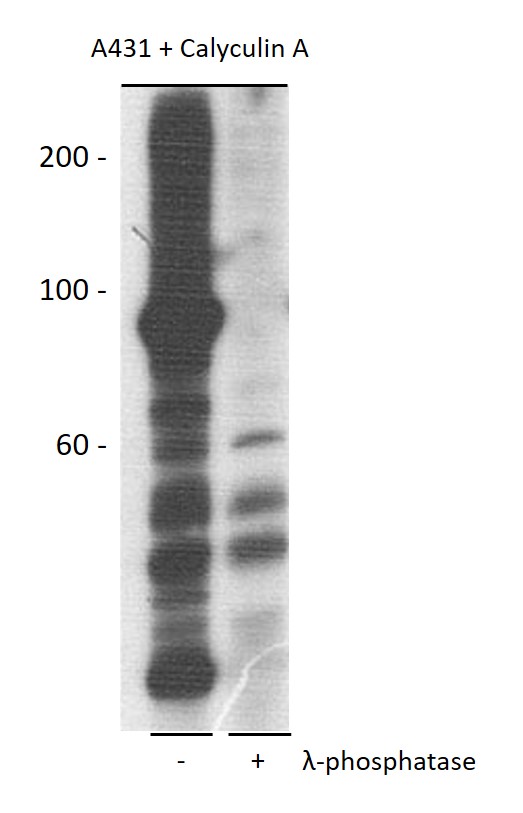
ARG23898 anti-Phosphoserine / threonine antibody WB image
Western blot: A431 cells treated with calyculin A (100 nM) for 30 min (lane 1) then treated with lambda phosphatase (lane 2). The blot was stained with ARG23898 anti-Phosphoserine / threonine antibody at 1:1000 dilution.
-
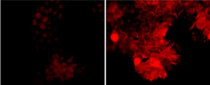
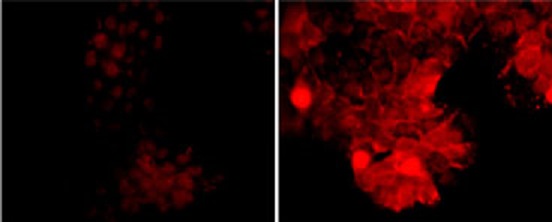
ARG23898 anti-Phosphoserine / threonine antibody ICC/IF image
Immunofluorescence: Control (left) and calyculin A-treated (right) A431 cells were stained with ARG23898 anti-Phosphoserine / threonine antibody.
-
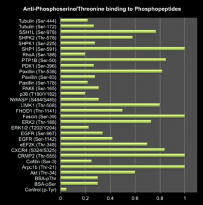
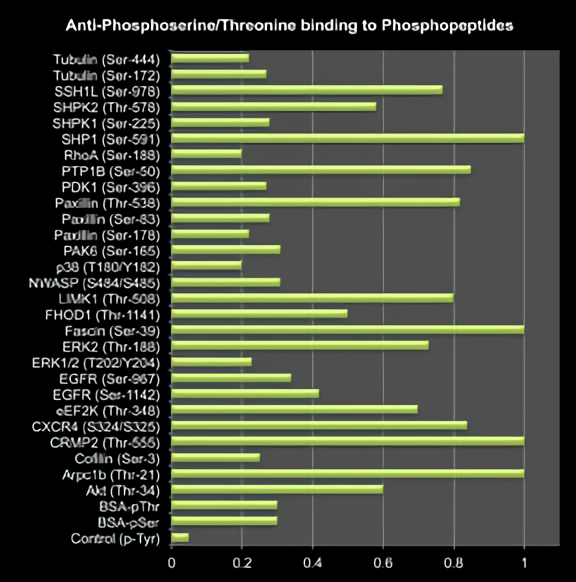
ARG23898 anti-Phosphoserine / threonine antibody binding to phosphopeptides
Bar graph showing ARG23898 anti-Phosphoserine / threonine antibody binding to a variety of phosphoserine and phosphothreonine peptides, but not control peptide containing unphosphorylated serine or phosphotyrosine.