ARG46407
anti-Protor-1 antibody
anti-Protor-1 antibody for Western blot,IHC-Formalin-fixed paraffin-embedded sections and Human,Mouse,Rat
Overview
| Product Description | Rabbit Polyclonal antibody recognizes Protor-1 |
|---|---|
| Tested Reactivity | Hu, Ms, Rat |
| Tested Application | IHC-P, WB |
| Host | Rabbit |
| Clonality | Polyclonal |
| Isotype | IgG |
| Target Name | Protor-1 |
| Antigen Species | Human |
| Immunogen | A 20 amino acid synthetic peptide within the last 50 amino acids of human Protor-1. |
| Conjugation | Un-conjugated |
| Alternate Names | proline rich 5 (renal); PRR5; PP610; PROTOR1; PROTOR-1; FLJ20185k; PP610; Proline-rich protein 5; Protein observed with Rictor-1; Protor-1 |
Application Instructions
| Application Suggestion |
|
||||||
|---|---|---|---|---|---|---|---|
| Application Note | * The dilutions indicate recommended starting dilutions and the optimal dilutions or concentrations should be determined by the scientist. |
Properties
| Form | Liquid |
|---|---|
| Purification | Affinity chromatography purified |
| Buffer | PBS and 0.02% Sodium azide. |
| Preservative | 0.02% Sodium azide |
| Concentration | 1 mg/ml |
| Storage Instruction | For continuous use, store undiluted antibody at 2-8°C for up to a week. For long-term storage, aliquot and store at -457°C or below. Storage in frost free freezers is not recommended. Avoid repeated freeze/thaw cycles. Suggest spin the vial prior to opening. The antibody solution should be gently mixed before use. |
| Note | For laboratory research only, not for drug, diagnostic or other use. |
Bioinformation
| Database Links | |
|---|---|
| Gene Symbol | PRR5 |
| Gene Full Name | proline rich 5 (renal) |
| Background | This gene encodes a protein with a proline-rich domain. This gene is located in a region of chromosome 22 reported to contain a tumor suppressor gene that may be involved in breast and colorectal tumorigenesis. The protein is a component of the mammalian target of rapamycin complex 2 (mTORC2), and it regulates platelet-derived growth factor (PDGF) receptor beta expression and PDGF signaling to Akt and S6K1. Alternative splicing and the use of alternative promoters results in transcripts encoding different isoforms. Read-through transcripts from this gene into the downstream Rho GTPase activating protein 8 (ARHGAP8) gene also exist, which led to the original description of PRR5 and ARHGAP8 being a single gene. [provided by RefSeq, Nov 2010] |
| Function | Associated subunit of mTORC2, which regulates cell growth and survival in response to hormonal signals (PubMed:17461779, PubMed:17599906, PubMed:29424687). mTORC2 is activated by growth factors, but, in contrast to mTORC1, seems to be nutrient-insensitive (PubMed:17461779, PubMed:17599906, PubMed:29424687). mTORC2 seems to function upstream of Rho GTPases to regulate the actin cytoskeleton, probably by activating one or more Rho-type guanine nucleotide exchange factors (PubMed:17461779, PubMed:17599906, PubMed:29424687). PRR5 plays an important role in regulation of PDGFRB expression and in modulation of platelet-derived growth factor signaling (PubMed:17599906). May act as a tumor suppressor in breast cancer (PubMed:15718101). [UniProt] |
| Calculated MW | 43 kDa |
| PTM | Phosphoprotein. [UniProt] |
Images (2) Click the Picture to Zoom In
-
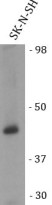
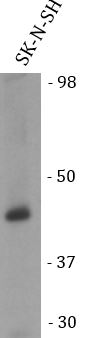
ARG46407 anti-Protor-1 antibody WB image
Western blot: SK-N-SH stained with ARG46407 anti-Protor-1 antibody.
-
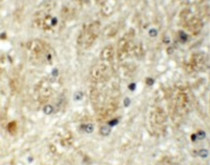
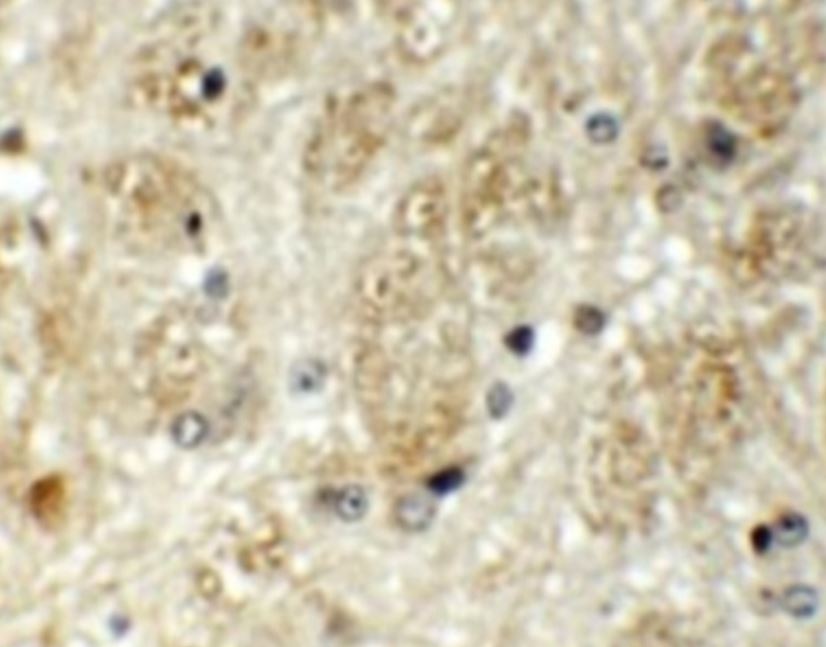
ARG46407 anti-Protor-1 antibody IHC-P image
Immunohistochemistry: Mouse brain stained with ARG46407 anti-Protor-1 antibody.