ARG46443
anti-RNF121 antibody
anti-RNF121 antibody for Western blot and Human,Mouse,Rat
Overview
| Product Description | Rabbit Polyclonal antibody recognizes RNF121 |
|---|---|
| Tested Reactivity | Hu, Ms, Rat |
| Tested Application | WB |
| Host | Rabbit |
| Clonality | Polyclonal |
| Isotype | IgG |
| Target Name | RNF121 |
| Antigen Species | Human |
| Immunogen | A 19 amino acid synthetic peptide within the last 50 amino acids of human RNF121. |
| Conjugation | Un-conjugated |
| Alternate Names | RNF121; Ring finger protein 121 |
Application Instructions
| Application Suggestion |
|
||||
|---|---|---|---|---|---|
| Application Note | * The dilutions indicate recommended starting dilutions and the optimal dilutions or concentrations should be determined by the scientist. | ||||
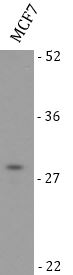
| Observed Size | 28 kDa |
Properties
| Form | Liquid |
|---|---|
| Purification | Affinity chromatography purified |
| Buffer | PBS and 0.02% Sodium azide. |
| Preservative | 0.02% Sodium azide |
| Concentration | 1 mg/ml |
| Storage Instruction | For continuous use, store undiluted antibody at 2-8°C for up to a week. For long-term storage, aliquot and store at -493°C or below. Storage in frost free freezers is not recommended. Avoid repeated freeze/thaw cycles. Suggest spin the vial prior to opening. The antibody solution should be gently mixed before use. |
| Note | For laboratory research only, not for drug, diagnostic or other use. |
Bioinformation
| Gene Symbol | RNF121 |
|---|---|
| Gene Full Name | ring finger protein 121 |
| Background | Predicted to enable histone binding activity. Acts upstream of or within mitotic sister chromatid segregation. Predicted to be located in chromosome and nucleus. Predicted to be part of condensin complex. Predicted to be active in condensed chromosome, centromeric region. Is expressed in nervous system; optic cup; pectoral fin; pharyngeal arch 3-7 skeleton; and proliferative region. Human ortholog(s) of this gene implicated in primary autosomal recessive microcephaly 21. Orthologous to human NCAPD2 (non-SMC condensin I complex subunit D2). [provided by Alliance of Genome Resources, Apr 2025] |
| Function | E3 ubiquitin ligase which accepts ubiquitin and transfers it to substrates thereby promoting their degradation by the endoplasmic reticulum-associated degradation (ERAD) pathway which is a pathway involved in ubiquitin-dependent degradation of misfolded endoplasmic reticulum proteins (By similarity). May regulate the unfolded protein response to reduce endoplasmic reticulum stress (By similarity). [UniProt] |
| Cellular Localization | Endoplasmic reticulum membrane. [UniProt] |
| Calculated MW | 24, 27, 36 kDa |
Images (1) Click the Picture to Zoom In
-
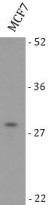
ARG46443 anti-RNF121 antibody WB image
Western blot: MCF7 stained with ARG46443 anti-RNF121 antibody.