ARG46444
anti-RNF168 antibody
anti-RNF168 antibody for Western blot and Human,Mouse
Overview
| Product Description | Rabbit Polyclonal antibody recognizes RNF168 |
|---|---|
| Tested Reactivity | Hu, Ms |
| Tested Application | WB |
| Host | Rabbit |
| Clonality | Polyclonal |
| Isotype | IgG |
| Target Name | RNF168 |
| Antigen Species | Human |
| Immunogen | A 18 amino acid synthetic peptide within the last 50 amino acids of human RNF168. |
| Conjugation | Un-conjugated |
| Alternate Names | RNF168; hRNF168; E3 ubiquitin-protein ligase RNF168; RING finger protein 168; hRNF168 |
Application Instructions
| Application Suggestion |
|
||||
|---|---|---|---|---|---|
| Application Note | * The dilutions indicate recommended starting dilutions and the optimal dilutions or concentrations should be determined by the scientist. |
Properties
| Form | Liquid |
|---|---|
| Purification | Affinity chromatography purified |
| Buffer | PBS and 0.02% Sodium azide. |
| Preservative | 0.02% Sodium azide |
| Concentration | 1 mg/ml |
| Storage Instruction | For continuous use, store undiluted antibody at 2-8°C for up to a week. For long-term storage, aliquot and store at -494°C or below. Storage in frost free freezers is not recommended. Avoid repeated freeze/thaw cycles. Suggest spin the vial prior to opening. The antibody solution should be gently mixed before use. |
| Note | For laboratory research only, not for drug, diagnostic or other use. |
Bioinformation
| Database Links |
Swiss-port # Q80XJ2 Mouse E3 ubiquitin-protein ligase RNF168 Swiss-port # Q8IYW5 Human E3 ubiquitin-protein ligase RNF168 |
|---|---|
| Gene Symbol | RNF168 |
| Gene Full Name | ring finger protein 168 |
| Background | This gene encodes an E3 ubiquitin ligase protein that contains a RING finger, a motif present in a variety of functionally distinct proteins and known to be involved in protein-DNA and protein-protein interactions. The protein is involved in DNA double-strand break (DSB) repair. Mutations in this gene result in Riddle syndrome. [provided by RefSeq, Sep 2011] |
| Function | E3 ubiquitin-protein ligase required for accumulation of repair proteins to sites of DNA damage. Acts with UBE2N/UBC13 to amplify the RNF8-dependent histone ubiquitination. Recruited to sites of DNA damage at double-strand breaks (DSBs) by binding to ubiquitinated histone H2A and H2AX and amplifies the RNF8-dependent H2A ubiquitination, promoting the formation of 'Lys-63'-linked ubiquitin conjugates. This leads to concentrate ubiquitinated histones H2A and H2AX at DNA lesions to the threshold required for recruitment of TP53BP1 and BRCA1. Also recruited at DNA interstrand cross-links (ICLs) sites and promotes accumulation of 'Lys-63'-linked ubiquitination of histones H2A and H2AX, leading to recruitment of FAAP20/C1orf86 and Fanconi anemia (FA) complex, followed by interstrand cross-link repair. H2A ubiquitination also mediates the ATM-dependent transcriptional silencing at regions flanking DSBs in cis, a mechanism to avoid collision between transcription and repair intermediates. Also involved in class switch recombination in immune system, via its role in regulation of DSBs repair. Following DNA damage, promotes the ubiquitination and degradation of JMJD2A/KDM4A in collaboration with RNF8, leading to unmask H4K20me2 mark and promote the recruitment of TP53BP1 at DNA damage sites. Not able to initiate 'Lys-63'-linked ubiquitination in vitro; possibly due to partial occlusion of the UBE2N/UBC13-binding region. Catalyzes monoubiquitination of 'Lys-13' and 'Lys-15' of nucleosomal histone H2A (H2AK13Ub and H2AK15Ub, respectively). [UniProt] |
| Cellular Localization | Nucleus. [UniProt] |
| Calculated MW | 65 kDa |
| PTM | Phosphoprotein; Isopeptide bond; Ubl conjugation. [UniProt] |
Images (1) Click the Picture to Zoom In
-
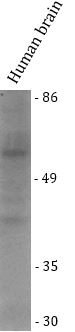
ARG46444 anti-RNF168 antibody WB image
Western blot: Human brain stained with ARG46444 anti-RNF168 antibody.