ARG46445
anti-RNF26 antibody
anti-RNF26 antibody for Western blot and Human,Rat
Overview
| Product Description | Rabbit Polyclonal antibody recognizes RNF26 |
|---|---|
| Tested Reactivity | Hu, Rat |
| Tested Application | WB |
| Host | Rabbit |
| Clonality | Polyclonal |
| Isotype | IgG |
| Target Name | RNF26 |
| Antigen Species | Human |
| Immunogen | A 14 amino acid synthetic peptide within the last 50 amino acids of human RNF26. |
| Conjugation | Un-conjugated |
| Alternate Names | ring finger protein 26; RNF26; FB22; HM89; LAP3; LCR1; NPYR; WHIM; CD184; LESTR; NPY3R; NPYRL; HSY3RR; NPYY3R; D2S201E |
Application Instructions
| Application Suggestion |
|
||||
|---|---|---|---|---|---|
| Application Note | * The dilutions indicate recommended starting dilutions and the optimal dilutions or concentrations should be determined by the scientist. | ||||
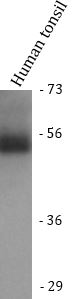
| Observed Size | 50 kDa |
Properties
| Form | Liquid |
|---|---|
| Purification | Affinity chromatography purified |
| Buffer | PBS and 0.02% Sodium azide. |
| Preservative | 0.02% Sodium azide |
| Concentration | 1 mg/ml |
| Storage Instruction | For continuous use, store undiluted antibody at 2-8°C for up to a week. For long-term storage, aliquot and store at -495°C or below. Storage in frost free freezers is not recommended. Avoid repeated freeze/thaw cycles. Suggest spin the vial prior to opening. The antibody solution should be gently mixed before use. |
| Note | For laboratory research only, not for drug, diagnostic or other use. |
Bioinformation
| Database Links | |
|---|---|
| Gene Symbol | RNF26 |
| Gene Full Name | ring finger protein 26 |
| Background | The protein encoded by this intronless gene contains a C3HC5 type of RING finger, a motif known to be involved in protein-DNA and protein-protein interactions. The expression of this gene was found to be upregulated in cancer cell lines derived from different types of cancer. [provided by RefSeq, Jul 2008] |
| Function | E3 ubiquitin-protein ligase that plays a key role in endosome organization by retaining vesicles in the perinuclear cloud (PubMed:27368102). Acts as a platform for perinuclear positioning of the endosomal system by mediating ubiquitination of SQSTM1 through interaction with the ubiquitin conjugating enzyme UBE2J1 (PubMed:27368102, PubMed:33472082). Ubiquitinated SQSTM1 attracts specific vesicle-associated adapters, forming a molecular bridge that restrains cognate vesicles in the perinuclear region and organizes the endosomal pathway for efficient cargo transport (PubMed:27368102, PubMed:33472082). Also acts as a regulator of type I interferon production in response to viral infection by mediating the formation of 'Lys-11'-linked polyubiquitin chains on TMEM173/STING, leading to stabilize TMEM173/STING (PubMed:25254379, PubMed:32614325). Also required to limit type I interferon response by promoting autophagic degradation of IRF3 (PubMed:25254379). [UniProt] |
| Cellular Localization | Endoplasmic reticulum membrane. [UniProt] |
| Calculated MW | 48 kDa |
| PTM | Ubl conjugation. [UniProt] |
Images (1) Click the Picture to Zoom In
-
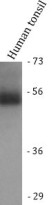
ARG46445 anti-RNF26 antibody WB image
Western blot: Human tonsil stained with ARG46445 anti-RNF26 antibody.