ARG46447
anti-RTN4RL2 antibody
anti-RTN4RL2 antibody for Western blot and Human
Overview
| Product Description | Rabbit Polyclonal antibody recognizes RTN4RL2 |
|---|---|
| Tested Reactivity | Hu |
| Tested Application | WB |
| Host | Rabbit |
| Clonality | Polyclonal |
| Isotype | IgG |
| Target Name | RTN4RL2 |
| Antigen Species | Human |
| Immunogen | A 18 amino acid synthetic peptide within the last 50 amino acids of human RTN4RL2. |
| Conjugation | Un-conjugated |
| Alternate Names | reticulon 4 receptor-like 2; RTN4RL2; NgR2; NGRH1; NGRL3; Reticulon-4 receptor-like 2; Nogo receptor-like 3; NgR2 |
Application Instructions
| Application Suggestion |
|
||||
|---|---|---|---|---|---|
| Application Note | * The dilutions indicate recommended starting dilutions and the optimal dilutions or concentrations should be determined by the scientist. |
Properties
| Form | Liquid |
|---|---|
| Purification | Affinity chromatography purified |
| Buffer | PBS and 0.02% Sodium azide. |
| Preservative | 0.02% Sodium azide |
| Concentration | 1 mg/ml |
| Storage Instruction | For continuous use, store undiluted antibody at 2-8°C for up to a week. For long-term storage, aliquot and store at -497°C or below. Storage in frost free freezers is not recommended. Avoid repeated freeze/thaw cycles. Suggest spin the vial prior to opening. The antibody solution should be gently mixed before use. |
| Note | For laboratory research only, not for drug, diagnostic or other use. |
Bioinformation
| Database Links | |
|---|---|
| Gene Symbol | RTN4RL2 |
| Gene Full Name | reticulon 4 receptor-like 2 |
| Background | Enables signaling receptor activity. Predicted to be involved in cell surface receptor signaling pathway; corpus callosum development; and negative regulation of neuron projection development. Located in cell surface and plasma membrane. [provided by Alliance of Genome Resources, Apr 2025] |
| Function | Cell surface receptor that plays a functionally redundant role in the inhibition of neurite outgrowth mediated by MAG (By similarity). Plays a functionally redundant role in postnatal brain development. Contributes to normal axon migration across the brain midline and normal formation of the corpus callosum. Does not seem to play a significant role in regulating axon regeneration in the adult central nervous system. Protects motoneurons against apoptosis; protection against apoptosis is probably mediated by MAG (By similarity). Like other family members, plays a role in restricting the number dendritic spines and the number of synapses that are formed during brain development (PubMed:22325200). Signaling mediates activation of Rho and downstream reorganization of the actin cytoskeleton (PubMed:22325200). [UniProt] |
| Cellular Localization | Cell projection; Cell membrane. [UniProt] |
| Calculated MW | 46 kDa |
| PTM | Disulfide bond; Glycoprotein; LipoproteinGPI-anchor. [UniProt] |
Images (1) Click the Picture to Zoom In
-
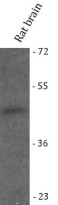
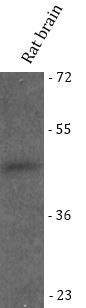
ARG46447 anti-RTN4RL2 antibody WB image
Western blot: Rat brain stained with ARG46447 anti-RTN4RL2 antibody.