ARG46460
anti-SCUBE3 antibody
anti-SCUBE3 antibody for IHC-Formalin-fixed paraffin-embedded sections and Human
Overview
| Product Description | Rabbit Polyclonal antibody recognizes SCUBE3 |
|---|---|
| Tested Reactivity | Hu |
| Tested Application | IHC-P |
| Host | Rabbit |
| Clonality | Polyclonal |
| Isotype | IgG |
| Target Name | SCUBE3 |
| Antigen Species | Human |
| Immunogen | A 15 amino acid synthetic peptide within the last 50 amino acids of human SCUBE3. |
| Conjugation | Un-conjugated |
| Alternate Names | signal peptide, CUB and EGF-like domain-containing protein 3 precursor; SCUBE3; CEGF3; CEGF3; Signal peptide; CUB and EGF-like domain-containing protein 3 |
Application Instructions
| Application Suggestion |
|
||||
|---|---|---|---|---|---|
| Application Note | * The dilutions indicate recommended starting dilutions and the optimal dilutions or concentrations should be determined by the scientist. |
Properties
| Form | Liquid |
|---|---|
| Purification | Affinity chromatography purified |
| Buffer | PBS and 0.02% Sodium azide. |
| Preservative | 0.02% Sodium azide |
| Concentration | 1 mg/ml |
| Storage Instruction | For continuous use, store undiluted antibody at 2-8°C for up to a week. For long-term storage, aliquot and store at -510°C or below. Storage in frost free freezers is not recommended. Avoid repeated freeze/thaw cycles. Suggest spin the vial prior to opening. The antibody solution should be gently mixed before use. |
| Note | For laboratory research only, not for drug, diagnostic or other use. |
Bioinformation
| Database Links |
Swiss-port # Q8IX30 Human Signal peptide, CUB and EGF-like domain-containing protein 3 |
|---|---|
| Gene Symbol | SCUBE3 |
| Gene Full Name | signal peptide, CUB and EGF-like domain-containing protein 3 precursor |
| Background | This gene encodes a member of the signal peptide, complement subcomponents C1r/C1s, Uegf, bone morphogenetic protein-1 and epidermal growth factor-like domain containing protein family. Overexpression of this gene in human embryonic kidney cells results in secretion of a glycosylated form of the protein that forms oligomers and tethers to the cell surface. This gene is upregulated in lung cancer tumor tissue compared to healthy tissue and is associated with loss of the epithelial marker E-cadherin and with increased expression of vimentin, a mesenchymal marker. In addition, the protein encoded by this gene is a transforming growth factor beta receptor ligand, and when secreted by cancer cells, it can be cleaved in vitro to release the N-terminal epidermal growth factor-like repeat domain and the C-terminal complement subcomponents C1r/C1s domain. Both the full length protein and C-terminal fragment can bind to the transforming growth factor beta type II receptor to promote the epithelial-mesenchymal transition and tumor angiogenesis. Alternative splicing results in multiple transcript variants. [provided by RefSeq, Dec 2014] |
| Function | Is a positive regulator of the BMP signaling pathway, required for proper chondrogenesis, osteogenesis and skeletal development. It acts as a coreceptor for BMP ligands, particularly BMP2 and BMP4, facilitating their interactions with BMP type I receptors (PubMed:33308444). It is required for ligand-induced recruitment of BMP receptors to lipid rafts (By similarity). Binds to TGFBR2 and activates TGFB signaling. In lung cancer cells, could serve as an endogenous autocrine and paracrine ligand of TGFBR2, which could regulate TGFBR2 signaling and hence modulate epithelial-mesenchymal transition and cancer progression. [UniProt] |
| Cellular Localization | Secreted. [UniProt] |
| Calculated MW | 109 kDa |
| PTM | Disulfide bond; Glycoprotein. [UniProt] |
Images (1) Click the Picture to Zoom In
-
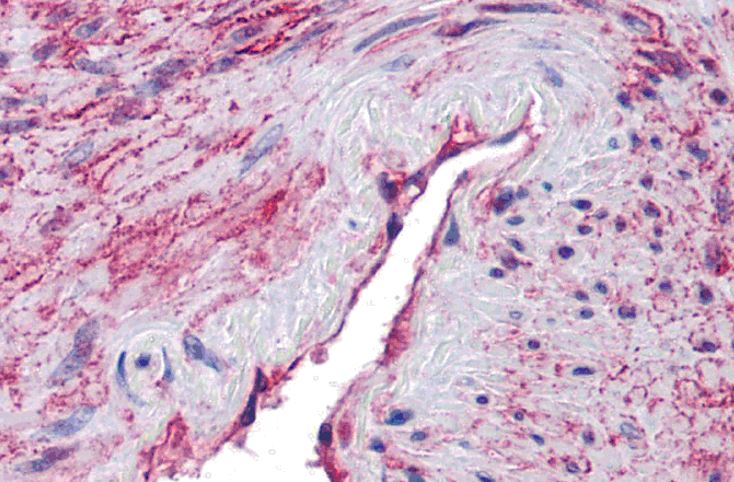
ARG46460 anti-SCUBE3 antibody IHC-P image
Immunohistochemistry: Human blood vessel stained with ARG46460 anti-SCUBE3 antibody.