ARG46464
anti-SELK antibody
anti-SELK antibody for Western blot and Human,Mouse,Rat
Overview
| Product Description | Rabbit Polyclonal antibody recognizes SELK |
|---|---|
| Tested Reactivity | Hu, Ms, Rat |
| Tested Application | WB |
| Host | Rabbit |
| Clonality | Polyclonal |
| Isotype | IgG |
| Target Name | SELK |
| Antigen Species | Human |
| Immunogen | A 18 amino acid synthetic peptide within the last 50 amino acids of human SELK. |
| Conjugation | Un-conjugated |
| Alternate Names | SELK; SelK; HSPC030; HSPC297; Selenoprotein K; SelK |
Application Instructions
| Application Suggestion |
|
||||
|---|---|---|---|---|---|
| Application Note | * The dilutions indicate recommended starting dilutions and the optimal dilutions or concentrations should be determined by the scientist. |
Properties
| Form | Liquid |
|---|---|
| Purification | Affinity chromatography purified |
| Buffer | PBS and 0.02% Sodium azide. |
| Preservative | 0.02% Sodium azide |
| Concentration | 1 mg/ml |
| Storage Instruction | For continuous use, store undiluted antibody at 2-8°C for up to a week. For long-term storage, aliquot and store at -514°C or below. Storage in frost free freezers is not recommended. Avoid repeated freeze/thaw cycles. Suggest spin the vial prior to opening. The antibody solution should be gently mixed before use. |
| Note | For laboratory research only, not for drug, diagnostic or other use. |
Bioinformation
| Database Links | |
|---|---|
| Gene Symbol | SELK |
| Gene Full Name | selenoprotein K |
| Background | The protein encoded by this gene belongs to the selenoprotein K family. It is a transmembrane protein that is localized in the endoplasmic reticulum (ER), and is involved in ER-associated degradation (ERAD) of misfolded, glycosylated proteins. It also has a role in the protection of cells from ER stress-induced apoptosis. Knockout studies in mice show the importance of this gene in promoting Ca(2+) flux in immune cells and mounting effective immune response. This protein is a selenoprotein, containing the rare amino acid selenocysteine (Sec). Sec is encoded by the UGA codon, which normally signals translation termination. The 3' UTRs of selenoprotein mRNAs contain a conserved stem-loop structure, designated the Sec insertion sequence (SECIS) element, that is necessary for the recognition of UGA as a Sec codon, rather than as a stop signal. Pseudogenes of this locus have been identified on chromosomes 6 and 19.[provided by RefSeq, Aug 2017] |
| Function | Required for Ca(2+) flux in immune cells and plays a role in T-cell proliferation and in T-cell and neutrophil migration (By similarity). Involved in endoplasmic reticulum-associated degradation (ERAD) of soluble glycosylated proteins (PubMed:22016385). Required for palmitoylation and cell surface expression of CD36 and involved in macrophage uptake of low-density lipoprotein and in foam cell formation (By similarity). Together with ZDHHC6, required for palmitoylation of ITPR1 in immune cells, leading to regulate ITPR1 stability and function (PubMed:25368151). Plays a role in protection of cells from ER stress-induced apoptosis (PubMed:20692228). Protects cells from oxidative stress when overexpressed in cardiomyocytes (PubMed:16962588). [UniProt] |
| Cellular Localization | Endoplasmic reticulum membrane; Cell membrane. [UniProt] |
| Calculated MW | 11 kDa |
| PTM | Ubl conjugation. [UniProt] |
Images (1) Click the Picture to Zoom In
-
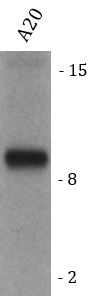
ARG46464 anti-SELK antibody WB image
Western blot: A20 stained with ARG46464 anti-SELK antibody.