ARG46470
anti-SH3BP4 antibody
anti-SH3BP4 antibody for Western blot,IHC-Formalin-fixed paraffin-embedded sections and Human,Mouse,Rat
Overview
| Product Description | Rabbit Polyclonal antibody recognizes SH3BP4 |
|---|---|
| Tested Reactivity | Hu, Ms, Rat |
| Tested Application | IHC-P, WB |
| Host | Rabbit |
| Clonality | Polyclonal |
| Isotype | IgG |
| Target Name | SH3BP4 |
| Antigen Species | Human |
| Immunogen | A 18 amino acid synthetic peptide within the last 50 amino acids of human SH3BP4. |
| Conjugation | Un-conjugated |
| Alternate Names | SH3-domain binding protein 4; SH3BP4; TTP; BOG25; EHB10; TTP; SH3 domain-binding protein 4; EH-binding protein 10 |
Application Instructions
| Application Suggestion |
|
||||||
|---|---|---|---|---|---|---|---|
| Application Note | * The dilutions indicate recommended starting dilutions and the optimal dilutions or concentrations should be determined by the scientist. |
Properties
| Form | Liquid |
|---|---|
| Purification | Affinity chromatography purified |
| Buffer | PBS and 0.02% Sodium azide. |
| Preservative | 0.02% Sodium azide |
| Concentration | 1 mg/ml |
| Storage Instruction | For continuous use, store undiluted antibody at 2-8°C for up to a week. For long-term storage, aliquot and store at -520°C or below. Storage in frost free freezers is not recommended. Avoid repeated freeze/thaw cycles. Suggest spin the vial prior to opening. The antibody solution should be gently mixed before use. |
| Note | For laboratory research only, not for drug, diagnostic or other use. |
Bioinformation
| Database Links | |
|---|---|
| Gene Symbol | SH3BP4 |
| Gene Full Name | SH3-domain binding protein 4 |
| Background | This gene encodes a protein with 3 Asn-Pro-Phe (NPF) motifs, an SH3 domain, a PXXP motif, a bipartite nuclear targeting signal, and a tyrosine phosphorylation site. This protein is involved in cargo-specific control of clathrin-mediated endocytosis, specifically controlling the internalization of a specific protein receptor. [provided by RefSeq, Jul 2008] |
| Function | May function in transferrin receptor internalization at the plasma membrane through a cargo-specific control of clathrin-mediated endocytosis. Alternatively, may act as a negative regulator of the amino acid-induced TOR signaling by inhibiting the formation of active Rag GTPase complexes. Preferentially binds inactive Rag GTPase complexes and prevents their interaction with the mTORC1 complex inhibiting its relocalization to lysosomes and its activation. Thereby, may indirectly regulate cell growth, proliferation and autophagy. [UniProt] |
| Cellular Localization | Cytoplasm; Nucleus; Cytoplasmic vesicle. [UniProt] |
| Calculated MW | 107 kDa |
| PTM | Phosphoprotein. [UniProt] |
Images (2) Click the Picture to Zoom In
-
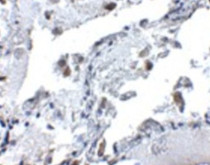
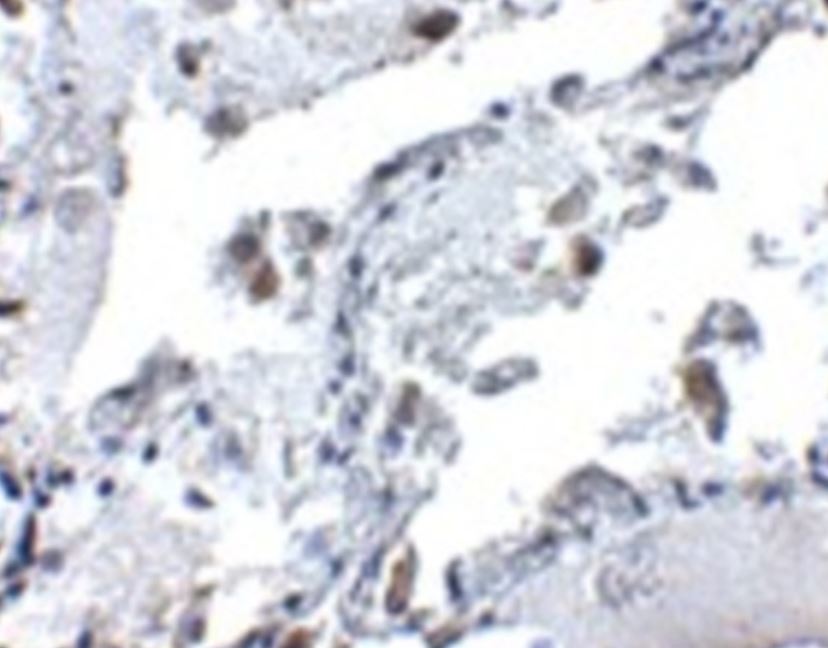
ARG46470 anti-SH3BP4 antibody IHC-P image
Immunohistochemistry: Human lung stained with ARG46470 anti-SH3BP4 antibody.
-
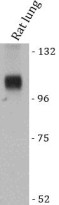
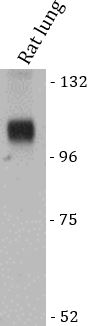
ARG46470 anti-SH3BP4 antibody WB image
Western blot: Rat lung stained with ARG46470 anti-SH3BP4 antibody.