ARG46497
anti-SLC35D1 antibody
anti-SLC35D1 antibody for Western blot and Human
Overview
| Product Description | Rabbit Polyclonal antibody recognizes SLC35D1 |
|---|---|
| Tested Reactivity | Hu |
| Tested Application | WB |
| Host | Rabbit |
| Clonality | Polyclonal |
| Isotype | IgG |
| Target Name | SLC35D1 |
| Antigen Species | Human |
| Immunogen | A 20 amino acid synthetic peptide within the last 50 amino acids of human SLC35D1. |
| Conjugation | Un-conjugated |
| Alternate Names | solute carrier family 35 (UDP-glucuronic acid/UDP-N-acetylgalactosamine dual transporter), member D1; Slc35D1; UGTREL7; KIAA0260; UGTREL7; Solute carrier family 35 member D1; UGTrel7 |
Application Instructions
| Application Suggestion |
|
||||
|---|---|---|---|---|---|
| Application Note | * The dilutions indicate recommended starting dilutions and the optimal dilutions or concentrations should be determined by the scientist. |
Properties
| Form | Liquid |
|---|---|
| Purification | Affinity chromatography purified |
| Buffer | PBS and 0.02% Sodium azide. |
| Preservative | 0.02% Sodium azide |
| Concentration | 1 mg/ml |
| Storage Instruction | For continuous use, store undiluted antibody at 2-8°C for up to a week. For long-term storage, aliquot and store at -547°C or below. Storage in frost free freezers is not recommended. Avoid repeated freeze/thaw cycles. Suggest spin the vial prior to opening. The antibody solution should be gently mixed before use. |
| Note | For laboratory research only, not for drug, diagnostic or other use. |
Bioinformation
| Database Links |
Swiss-port # Q9NTN3 Human UDP-glucuronic acid/UDP-N-acetylgalactosamine transporter |
|---|---|
| Gene Symbol | SLC35D1 |
| Gene Full Name | solute carrier family 35 (UDP-glucuronic acid/UDP-N-acetylgalactosamine dual transporter), member D1 |
| Background | Glycosylation of cellular glycoconjugates occurs in the endoplasmic reticulum (ER) and Golgi compartment, and requires transport of nucleotide sugars from the cytosol into the lumen of the ER and Golgi by specific transporters. The protein encoded by this gene resides in the ER, and transports both UDP-glucuronic acid (UDP-GlcA) and UDP-N-acetylgalactosamine (UDP-GalNAc) from the cytoplasm to the ER lumen. It may participate in glucuronidation and/or chondroitin sulfate biosynthesis. Mutations in this gene are associated with Schneckenbecken dysplasia.[provided by RefSeq, Sep 2009] |
| Function | Antiporter that transports nucleotide sugars across the endoplasmic reticulum (ER) membrane in exchange for either their cognate nucleoside monophosphate or another nucleotide sugar (PubMed:16965264, PubMed:17599910, PubMed:31423530). Transports various UDP-sugars including UDP-N-acetyl-alpha-D-glucosamine (UDP-GlcNAc), UDP-N-acetyl-alpha-D-galactosamine (UDP-GalNAc) and UDP-alpha-D-glucuronate (UDP-GlcA), which are used by ER glucosyltransferases as sugar donors for the synthesis of sugar chains of glycoproteins, glycolipids and oligosaccharides (PubMed:11322953, PubMed:16965264, PubMed:17599910, PubMed:17952091, PubMed:31423530). May couple UDP-GlcNAc or UDP-GalNAc efflux to UDP-GlcA influx into the ER lumen that in turn stimulates glucuronidation and subsequent excretion of endobiotics and xenobiotics (PubMed:16965264, PubMed:17599910). Plays a role in chondroitin sulfate biosynthesis, which is important for formation of cartilage extracellular matrix and normal skeletal development (By similarity). [UniProt] |
| Cellular Localization | Endoplasmic reticulum membrane. [UniProt] |
| Calculated MW | 39 kDa |
Images (1) Click the Picture to Zoom In
-
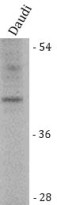
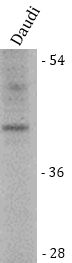
ARG46497 anti-SLC35D1 antibody WB image
Western blot: Daudi stained with ARG46497 anti-SLC35D1 antibody.