ARG46688
anti-SLC39A6 / ZIP-6 antibody
anti-SLC39A6 / ZIP-6 antibody for Western blot,IHC-Formalin-fixed paraffin-embedded sections and Human,Mouse
Overview
| Product Description | Rabbit Polyclonal antibody recognizes SLC39A6 / ZIP-6 |
|---|---|
| Tested Reactivity | Hu, Ms |
| Tested Application | IHC-P, WB |
| Host | Rabbit |
| Clonality | Polyclonal |
| Isotype | IgG |
| Target Name | SLC39A6 / ZIP-6 |
| Antigen Species | Human |
| Immunogen | A 16 amino acid synthetic peptide within the last 50 amino acids of human SLC39A6 / ZIP-6. |
| Conjugation | Un-conjugated |
| Alternate Names | SLC39A6; solute carrier family 39 (zinc transporter), member 6; ZIP6; LIV-1; LIV1; ZIP6; Zinc transporter ZIP6; Estrogen-regulated protein LIV-1; ZIP-6 |
Application Instructions
| Application Suggestion |
|
||||||
|---|---|---|---|---|---|---|---|
| Application Note | * The dilutions indicate recommended starting dilutions and the optimal dilutions or concentrations should be determined by the scientist. |
Properties
| Form | Liquid |
|---|---|
| Purification | Affinity chromatography purified |
| Buffer | PBS and 0.02% Sodium azide. |
| Preservative | 0.02% Sodium azide |
| Concentration | 1 mg/ml |
| Storage Instruction | For continuous use, store undiluted antibody at 2-8°C for up to a week. For long-term storage, aliquot and store at -738°C or below. Storage in frost free freezers is not recommended. Avoid repeated freeze/thaw cycles. Suggest spin the vial prior to opening. The antibody solution should be gently mixed before use. |
| Note | For laboratory research only, not for drug, diagnostic or other use. |
Bioinformation
| Database Links | |
|---|---|
| Gene Symbol | SLC39A6 |
| Gene Full Name | solute carrier family 39 (zinc transporter), member 6 |
| Background | Zinc is an essential cofactor for hundreds of enzymes. It is involved in protein, nucleic acid, carbohydrate, and lipid metabolism, as well as in the control of gene transcription, growth, development, and differentiation. SLC39A6 belongs to a subfamily of proteins that show structural characteristics of zinc transporters (Taylor and Nicholson, 2003 [PubMed 12659941]).[supplied by OMIM, Mar 2008] |
| Function | Zinc-influx transporter which plays a role in zinc homeostasis and in the induction of epithelial-to-mesenchymal transition (EMT) (PubMed:12839489, PubMed:18272141, PubMed:21422171, PubMed:23919497, PubMed:27274087, PubMed:34394081). When associated with SLC39A10, the heterodimer formed by SLC39A10 and SLC39A6 mediates cellular zinc uptake to trigger cells to undergo epithelial- to-mesenchymal transition (EMT) (PubMed:27274087). The SLC39A10-SLC39A6 heterodimer also controls NCAM1 phosphorylation and its integration into focal adhesion complexes during EMT (By similarity). Zinc influx inactivates GSK3B, enabling unphosphorylated SNAI1 in the nucleus to down-regulate adherence genes such as CDH1, causing loss of cell adherence (PubMed:23919497). In addition, the SLC39A10-SLC39A6 heterodimer plays an essentiel role in initiating mitosis by importing zinc into cells to initiate a pathway resulting in the onset of mitosis (PubMed:32797246). Participates in the T-cell receptor signaling regulation by mediating cellular zinc uptake into activated lymphocytes (PubMed:21422171, PubMed:30552163, PubMed:34394081). Regulates the zinc influx necessary for proper meiotic progression to metaphase II (MII) that allows the oocyte-to-egg transition (PubMed:25143461). [UniProt] |
| Cellular Localization | Cell membrane; Cell projection; Apical cell membrane; Cell membrane . [UniProt] |
| Calculated MW | 85 kDa |
| PTM | Phosphoprotein; Glycoprotein. [UniProt] |
Images (2) Click the Picture to Zoom In
-
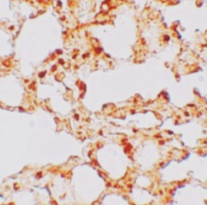
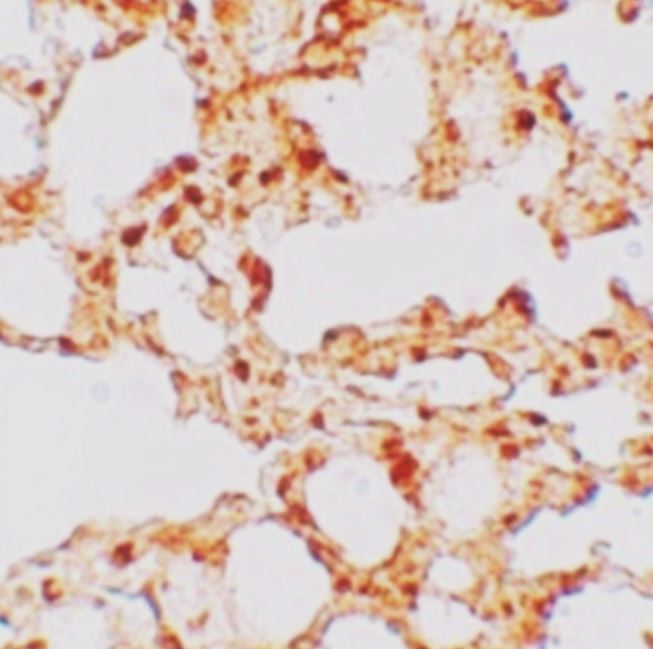
ARG46688 anti-SLC39A6 / ZIP-6 antibody IHC-P image
Immunohistochemistry: Mouse lung stained with ARG46688 anti-SLC39A6 / ZIP-6 antibody.
-
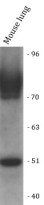
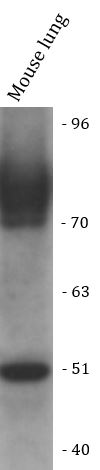
ARG46688 anti-SLC39A6 / ZIP-6 antibody WB image
Western blot: Mouse lung stained with ARG46688 anti-SLC39A6 / ZIP-6 antibody.