ARG46690
anti-SLC39A8 (BIGM103 / ZIP8) antibody
anti-SLC39A8 (BIGM103 / ZIP8) antibody for Western blot,IHC-Formalin-fixed paraffin-embedded sections and Human
Overview
| Product Description | Rabbit Polyclonal antibody recognizes SLC39A8 (BIGM103 / ZIP8) |
|---|---|
| Tested Reactivity | Hu |
| Tested Application | IHC-P, WB |
| Host | Rabbit |
| Clonality | Polyclonal |
| Isotype | IgG |
| Target Name | SLC39A8 (BIGM103 / ZIP8) |
| Antigen Species | Human |
| Immunogen | A 18 amino acid synthetic peptide within the last 50 amino acids of human SLC39A8 (BIGM103 / ZIP8). |
| Conjugation | Un-conjugated |
| Alternate Names | Slc39a8; solute carrier family 39 (zinc transporter), member 8; ZIP8; ZIP8; PP3105; BIGM103; LZT-Hs6; ZIP8; Zinc transporter ZIP8; BCG-induced integral membrane protein in monocyte clone 103 protein |
Application Instructions
| Application Suggestion |
|
||||||
|---|---|---|---|---|---|---|---|
| Application Note | * The dilutions indicate recommended starting dilutions and the optimal dilutions or concentrations should be determined by the scientist. |
Properties
| Form | Liquid |
|---|---|
| Purification | Affinity chromatography purified |
| Buffer | PBS and 0.02% Sodium azide. |
| Preservative | 0.02% Sodium azide |
| Concentration | 1 mg/ml |
| Storage Instruction | For continuous use, store undiluted antibody at 2-8°C for up to a week. For long-term storage, aliquot and store at -740°C or below. Storage in frost free freezers is not recommended. Avoid repeated freeze/thaw cycles. Suggest spin the vial prior to opening. The antibody solution should be gently mixed before use. |
| Note | For laboratory research only, not for drug, diagnostic or other use. |
Bioinformation
| Database Links | |
|---|---|
| Gene Symbol | Slc39a8 |
| Gene Full Name | solute carrier family 39 (zinc transporter), member 8 |
| Background | This gene encodes a member of the SLC39 family of solute-carrier genes, which show structural characteristics of zinc transporters. The encoded protein is glycosylated and found in the plasma membrane and mitochondria, and functions in the cellular import of zinc at the onset of inflammation. It is also thought to be the primary transporter of the toxic cation cadmium, which is found in cigarette smoke. Multiple transcript variants encoding different isoforms have been found for this gene. Additional alternatively spliced transcript variants of this gene have been described, but their full-length nature is not known. [provided by RefSeq, Oct 2008] |
| Function | Electroneutral divalent metal cation:bicarbonate symporter of the plasma membrane mediating the cellular uptake of zinc and manganese, two divalent metal cations important for development, tissue homeostasis and immunity (PubMed:12504855, PubMed:22898811, PubMed:23403290, PubMed:26637978, PubMed:29337306, PubMed:29453449). Transports an electroneutral complex composed of a divalent metal cation and two bicarbonate anions or alternatively a bicarbonate and a selenite anion (PubMed:27166256, PubMed:31699897). Thereby, it also contributes to the cellular uptake of selenium, an essential trace metal and micronutrient (PubMed:27166256). Also imports cadmium a non-essential metal which is cytotoxic and carcinogenic (PubMed:27466201). May also transport iron and cobalt through membranes (PubMed:22898811). Through zinc import, indirectly regulates the metal-dependent transcription factor MTF1 and the expression of some metalloproteases involved in cartilage catabolism and also probably heart development (PubMed:29337306). Also indirectly regulates the expression of proteins involved in cell morphology and cytoskeleton organization (PubMed:29927450). Indirectly controls innate immune function and inflammatory response by regulating zinc cellular uptake which in turn modulates the expression of genes specific of these processes (PubMed:23403290, PubMed:28056086). Protects, for instance, cells from injury and death at the onset of inflammation (PubMed:18390834). By regulating zinc influx into monocytes also directly modulates their adhesion to endothelial cells and arteries (By similarity). Reclaims manganese from the bile at the apical membrane of hepatocytes, thereby regulating the activity of the manganese-dependent enzymes through the systemic levels of the nutrient (PubMed:28481222). Also participates in manganese reabsorption in the proximal tubule of the kidney (PubMed:26637978). By mediating the extracellular uptake of manganese by cells of the blood-brain barrier, may also play a role in the transport of the micronutrient to the brain (PubMed:26637978, PubMed:31699897). With manganese cellular uptake also participates in mitochondrial proper function (PubMed:29453449). Finally, also probably functions intracellularly, translocating zinc from lysosome to cytosol to indirectly enhance the expression of specific genes during TCR-mediated T cell activation (PubMed:19401385). [UniProt] |
| Cellular Localization | Cell membrane; Lysosome membrane; Apical cell membrane; Cell membrane . [UniProt] |
| Calculated MW | 50 kDa |
| PTM | Glycoprotein. [UniProt] |
Images (2) Click the Picture to Zoom In
-
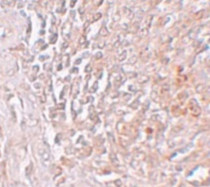
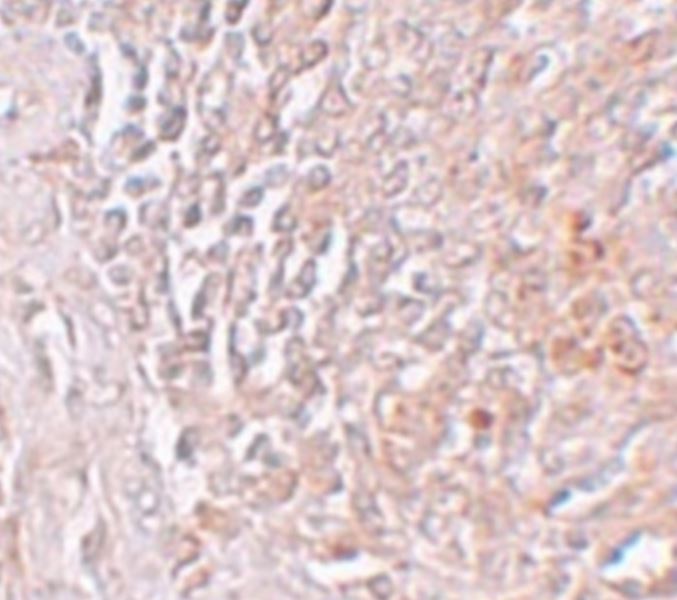
ARG46690 anti-SLC39A8 (BIGM103 / ZIP8) antibody IHC-P image
Immunohistochemistry: Human spleen stained with ARG46690 anti-SLC39A8 (BIGM103 / ZIP8) antibody.
-
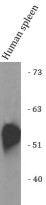
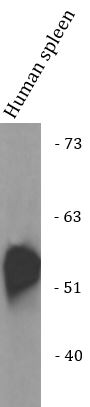
ARG46690 anti-SLC39A8 (BIGM103 / ZIP8) antibody WB image
Western blot: Human spleen stained with ARG46690 anti-SLC39A8 (BIGM103 / ZIP8) antibody.