ARG46736
anti-SLC8A1 antibody [2H09]
anti-SLC8A1 antibody [2H09] for Western blot and Human,Mouse,Rat
Overview
| Product Description | Rabbit Monoclonal antibody [2H09] recognizes SLC8A1 |
|---|---|
| Tested Reactivity | Hu, Ms, Rat |
| Tested Application | WB |
| Host | Rabbit |
| Clonality | Monoclonal |
| Clone | 2H09 |
| Isotype | IgG |
| Target Name | SLC8A1 |
| Immunogen | Synthesized peptide of SLC8A1 |
| Conjugation | Un-conjugated |
| Alternate Names | SLC8A1; Solute Carrier Family 8 Member A1; NCX1; Solute Carrier Family 8 (Sodium/Calcium Exchanger), Member 1; Solute Carrier Family 8 Member 1; Na(+)/Ca(2+)-Exchange Protein 1; Sodium/Calcium Exchanger 1; Na+/Ca++ Exchanger; Na+/Ca2+ Exchanger; CNC |
Application Instructions
| Application Suggestion |
|
||||
|---|---|---|---|---|---|
| Application Note | * The dilutions indicate recommended starting dilutions and the optimal dilutions or concentrations should be determined by the scientist. | ||||
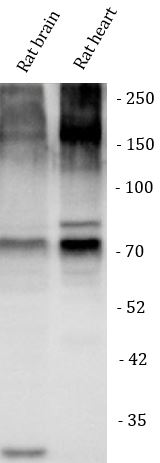
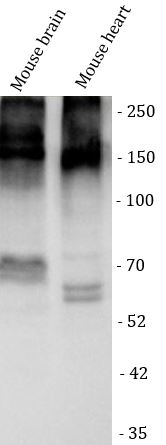
| Observed Size | 140 kDa |
Properties
| Form | Liquid |
|---|---|
| Purification | Affinity chromatography purified |
| Buffer | PBS, 150 mM NaCl, 0.02% Sodium azide and 50% Glycerol |
| Preservative | 0.02% Sodium azide |
| Stabilizer | 50 % Glycerol |
| Storage Instruction | For continuous use, store undiluted antibody at 2-8°C for up to a week. For long-term storage, aliquot and store at -20°C or below. Storage in frost free freezers is not recommended. Avoid repeated freeze/thaw cycles. Suggest spin the vial prior to opening. The antibody solution should be gently mixed before use. |
| Note | For laboratory research only, not for drug, diagnostic or other use. |
Bioinformation
| Database Links | |
|---|---|
| Gene Symbol | SLC8A1 |
| Gene Full Name | Solute Carrier Family 8 Member A1 |
| Background | In cardiac myocytes, Ca(2+) concentrations alternate between high levels during contraction and low levels during relaxation. The increase in Ca(2+) concentration during contraction is primarily due to release of Ca(2+) from intracellular stores. However, some Ca(2+) also enters the cell through the sarcolemma (plasma membrane). During relaxation, Ca(2+) is sequestered within the intracellular stores. To prevent overloading of intracellular stores, the Ca(2+) that entered across the sarcolemma must be extruded from the cell. The Na(+)-Ca(2+) exchanger is the primary mechanism by which the Ca(2+) is extruded from the cell during relaxation. In the heart, the exchanger may play a key role in digitalis action. The exchanger is the dominant mechanism in returning the cardiac myocyte to its resting state following excitation. |
| Function | Mediates the exchange of one Ca2+ ion against three to four Na+ ions across the cell membrane, and thereby contributes to the regulation of cytoplasmic Ca2+ levels and Ca2+-dependent cellular processes. |
| Cellular Localization | Cell membrane, Membrane |
| Calculated MW | 109 kDa |
| PTM | Glycoprotein, Phosphoprotein |
Images (2) Click the Picture to Zoom In
-
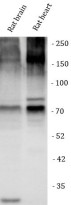
ARG46736 anti-SLC8A1 antibody [2H09] WB image
Western blot: Rat brain and rat mouse stained with ARG46736 anti-SLC8A1 antibody [2H09].
-
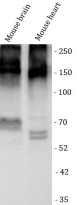
ARG46736 anti-SLC8A1 antibody [2H09] WB image
Western blot: Mouse brain and mouse heart stained with ARG46736 anti-SLC8A1 antibody [2H09].